How to design a listening system in the customer journey: visual guide

Design listening in five steps: moments, reference systems, tools, channels and times. A visual guide for use with woku or whichever platform you prefer.
A listening system connects what a person experiences with a decision made by your team. Designing it requires identifying moments, knowing where they are recorded and choosing how and when to collect the experience. You can implement it with woku, with other platforms or with tools that you already have.
1. Identify the moment
Delimit a journey, for example, a purchase with dispatch, and name the specific moments that you are interested in understanding: pre-sales service, purchase, delivery, first use or support. Identify who each one lives and what you could improve with their opinion. Whoever buys, receives and uses the product may be a different person.
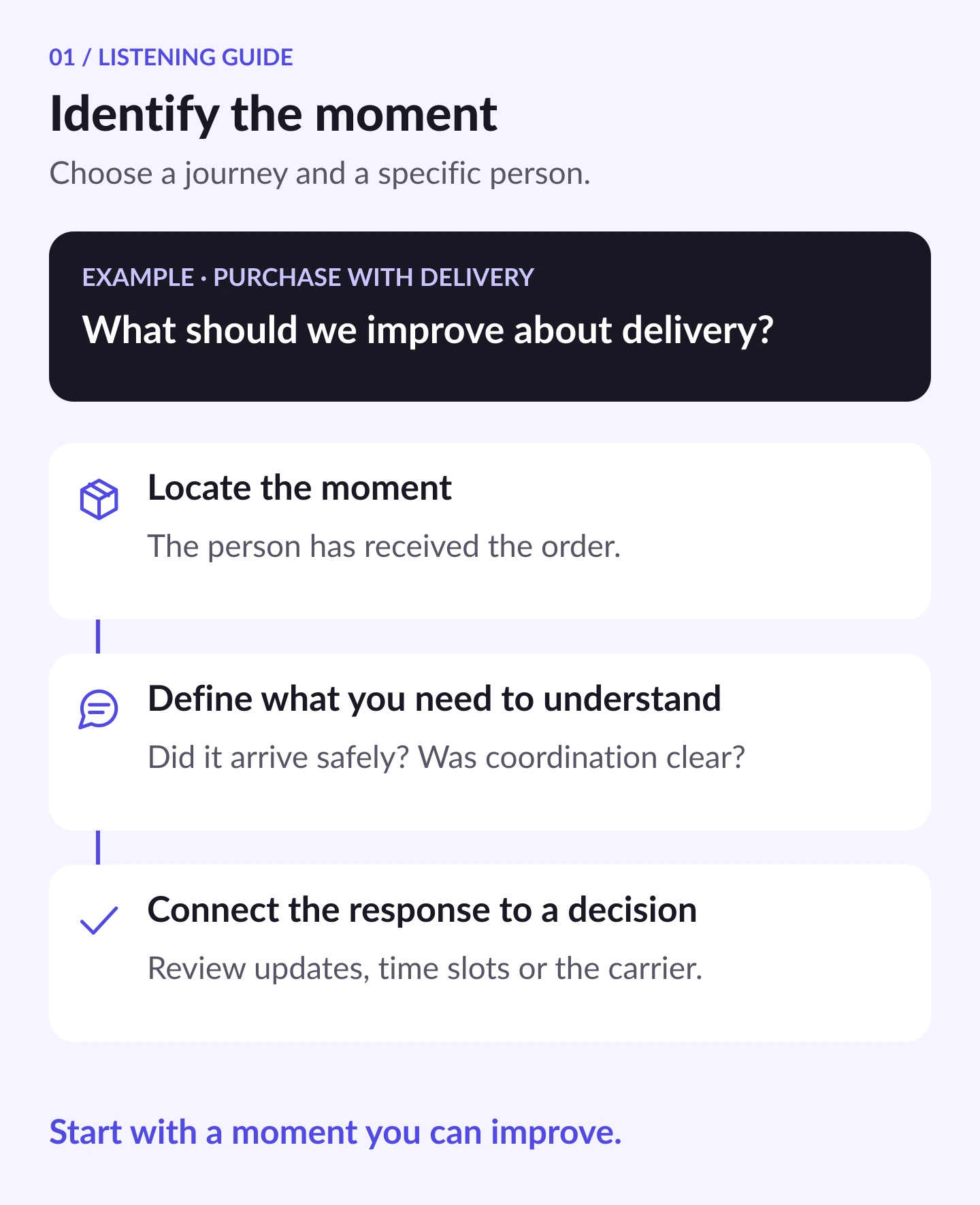
Choose recognizable facts, such as “you received the order”. To understand a pre-sale that didn't advance, also include those who didn't buy.
2. Identify where that moment is recorded
Before choosing a tool, identify which record you can locate that moment. It can be in a CRM, ERP, logistics software, support software or own software. The timing may have its own record or depend on another moment already recorded: the sale that comes from the CRM can also be used to schedule a loyalty listening one month later.
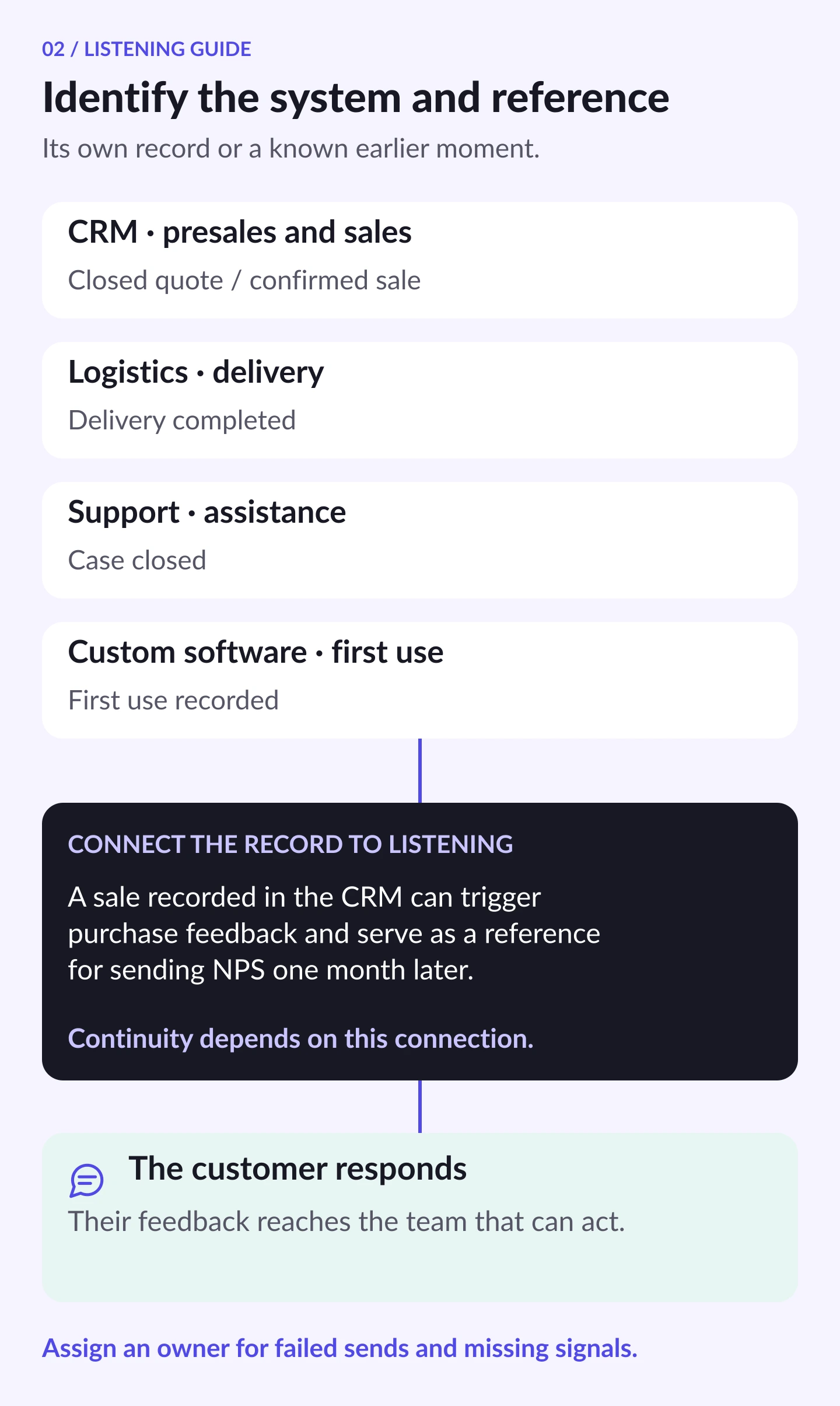
If there is no own record or a previous recorded moment to serve as a reference, it is not yet feasible to include it in a sustainable listening system. First solve that base. Loyalty doesn't need a new external record when it already depends on a known sale and a deadline.
In medium and large companies, depending on someone to remember to create or send a tool makes the system fragile. Connect the records of the operation with the listener to prepare or reuse the tool and send the invitation automatically, according to the agreed rules. The team continues to work on their usual systems.
The connection can be made using an available integration, API or SDK. At this stage, it is enough to identify the system, the case reference and the information that confirms the moment. Technical implementation comes later.
3. Choose the tool
Decide what you need to understand: satisfaction, ease, recommendation intention or opinion about a moment.
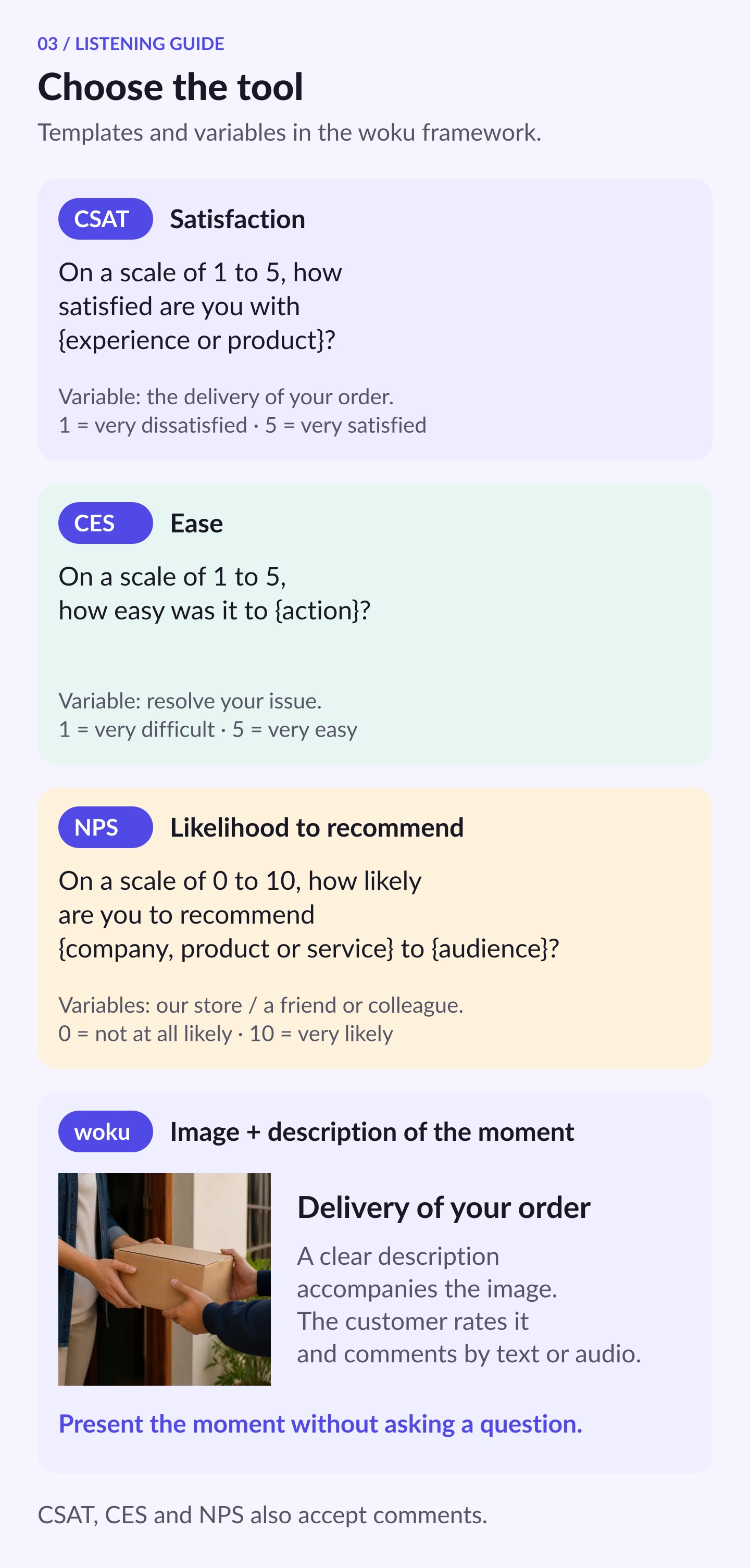
A woku is an image plus a description of the moment. For example, an image of the delivery accompanied by “Delivery of your order”. Present the experience without asking a question; the person rates it and shares their opinion via text or audio.
CSAT, CES, and NPS use questions with a fixed structure in woku. Complete the variables: the experience or product in CSAT; the action at CES; the company, product or service and the audience in NPS. The sheet shows the templates and examples of these variables.
CSAT and CES use 1 to 5. In CSAT, 1 is very dissatisfied and 5 is very satisfied; in CES, 1 is very difficult and 5 is very easy. NPS uses 0 to 10, from unlikely to very likely, and measures intention to recommend. Preserve structure and ends when comparing measurements.
4. Choose the channel
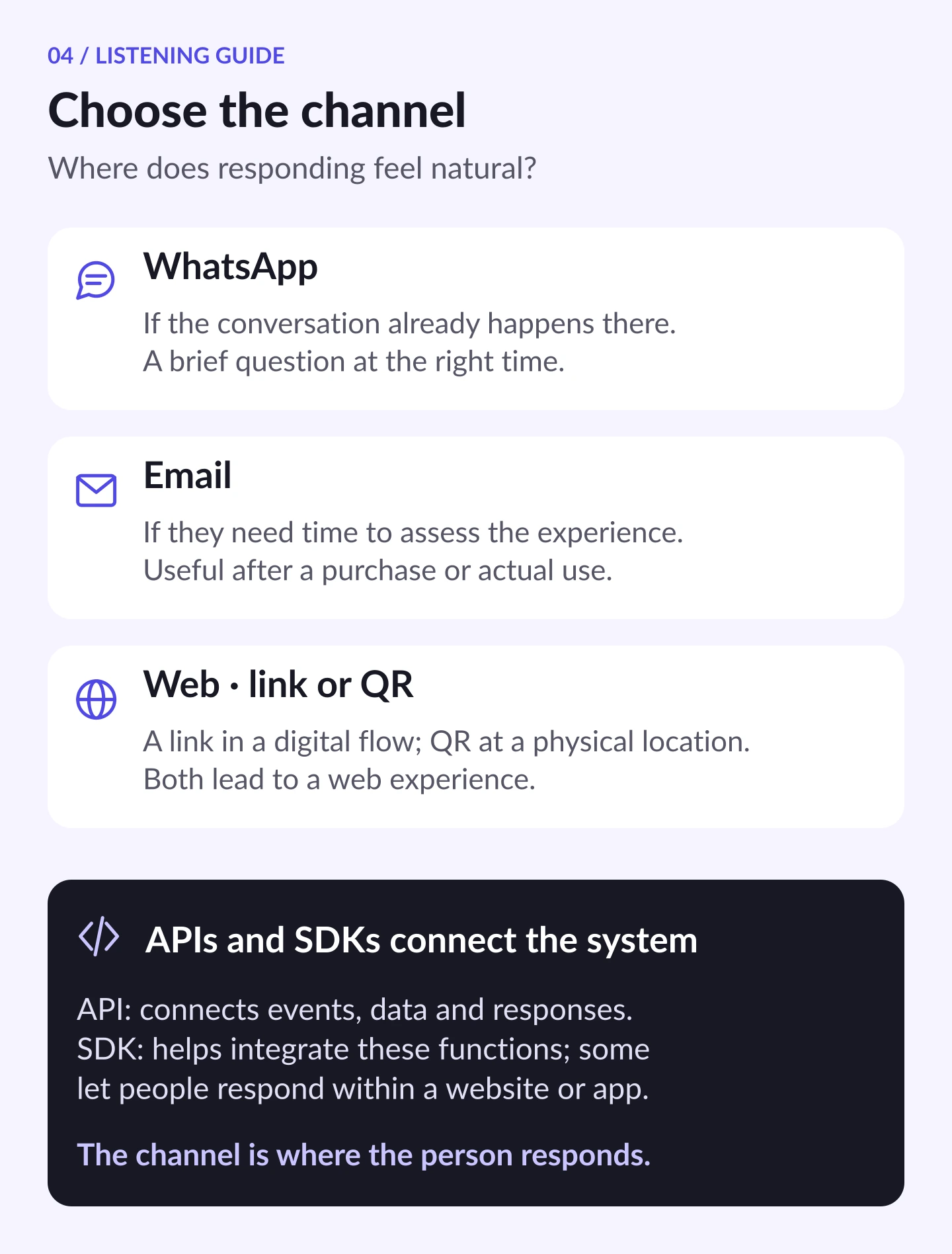
Prioritize the channel that person is already using with you. A QR invites you to respond in a physical place; a link accompanies a digital interaction. APIs and SDKs help connect the system, and some SDKs allow you to capture opinions within a website or app.
Coordinate frequency between teams and systems to avoid duplicate invitations. Explain what you're listening for and respect the decision not to participate.
5. Put the trip together and choose when to listen
Order the feasible moments and define when it makes sense to evaluate them. You can activate a measurement with a recorded event, such as a confirmed sale, or schedule it from a previous known time.
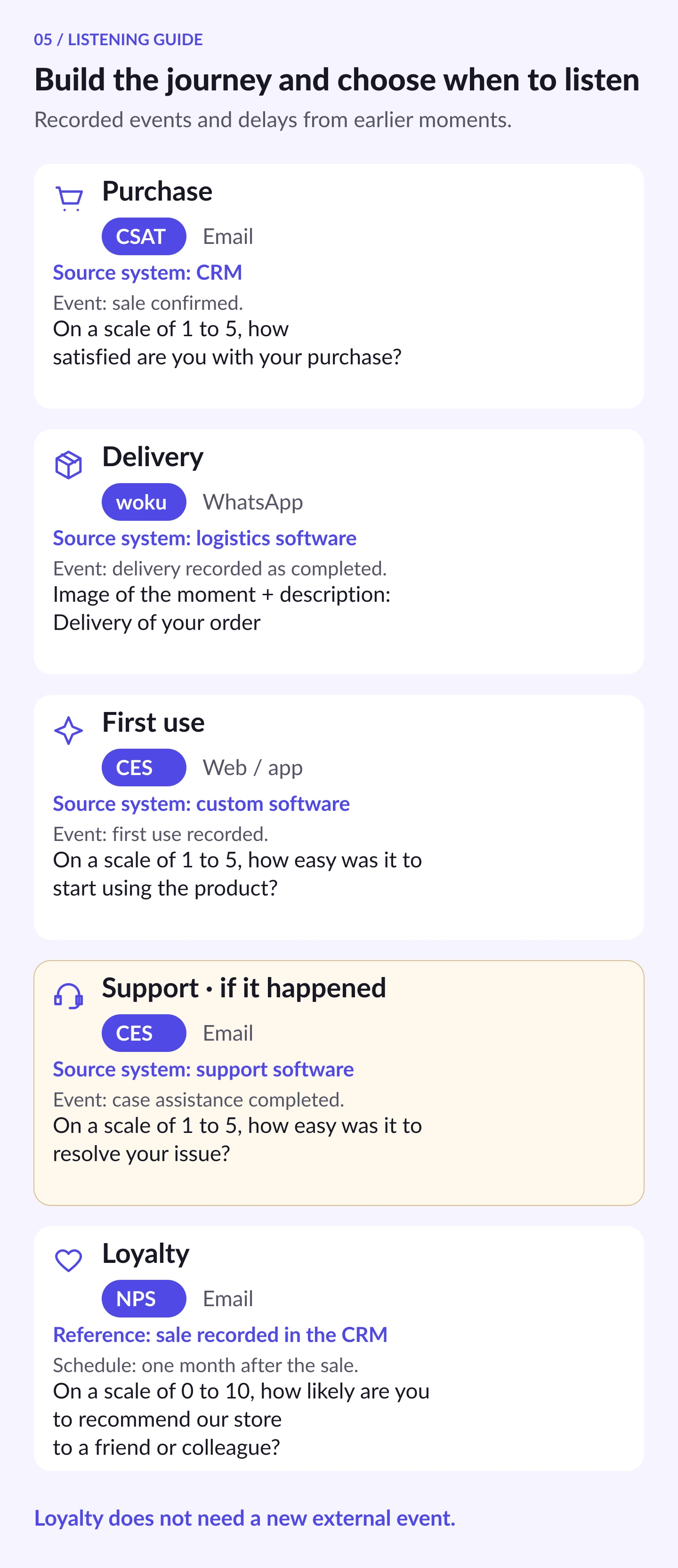
Example: The CRM communicates the sale and a month later the NPS is sent. The sale is the reference moment. Loyalty is programmed from that sale, without waiting for another event from the CRM or other software. You can agree on another deadline, for example, between 1 and 3 months, depending on the experience the person needs to live.
Support only applies to those who needed it. A cancellation may make subsequent shipments unnecessary. Keep the minimum context of each response: time, date, product or branch and purchase reference or case where appropriate.
Agree on what will happen after listening
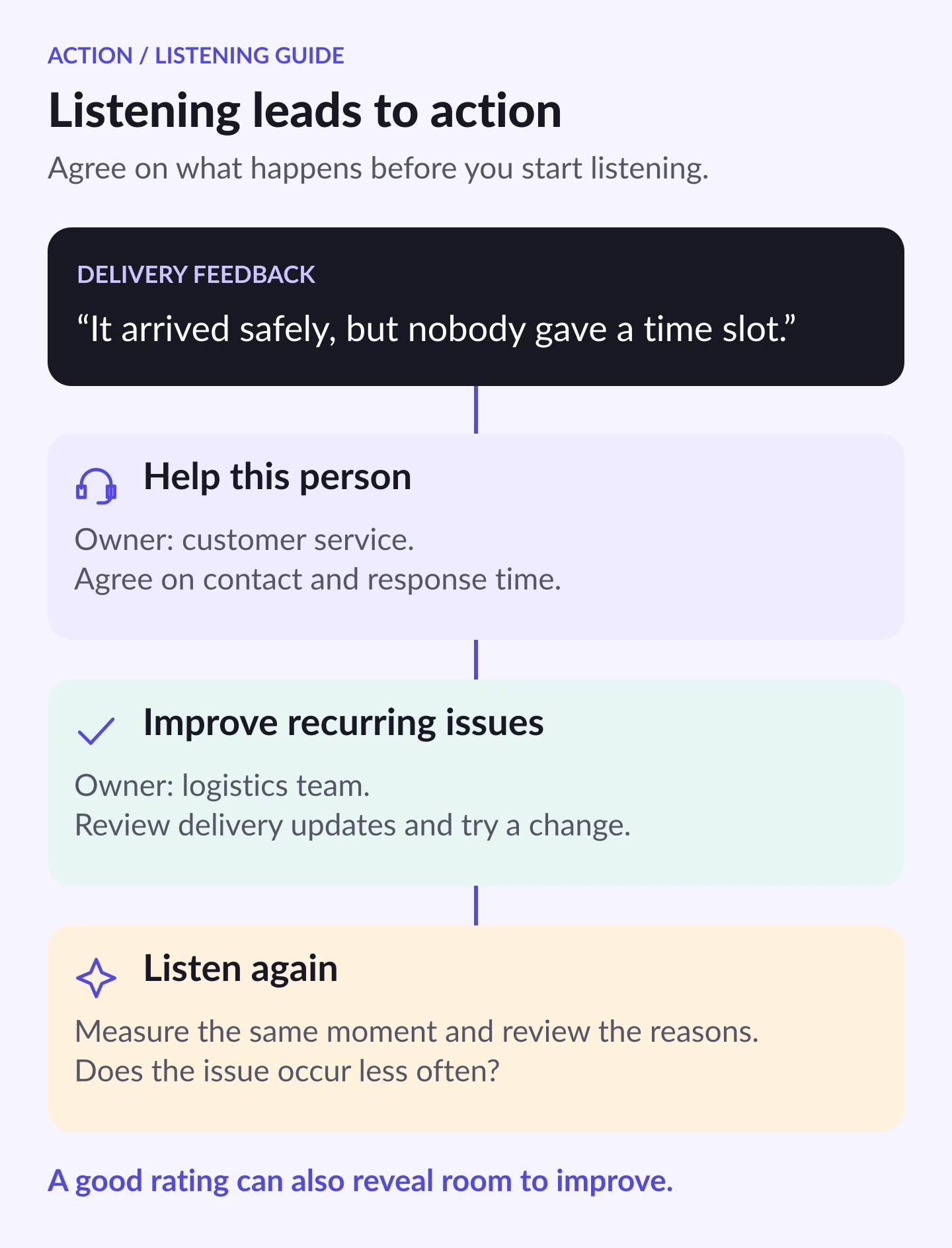
Define managers and deadlines both for responding to opinions and for reviewing failed invitations or registrations that don't arrive. If a reason is repeated, assign a process improvement and a date to evaluate it. If you can contact the person, let them know what was done with their comment.
Review the participation, the reasons and if the problem persists after the change. An open QR listens to those who decide to participate; it doesn't guarantee to represent everyone. Compare groups and equivalent moments, keep each metric separately, and consider the number of responses.
Your card to design every moment
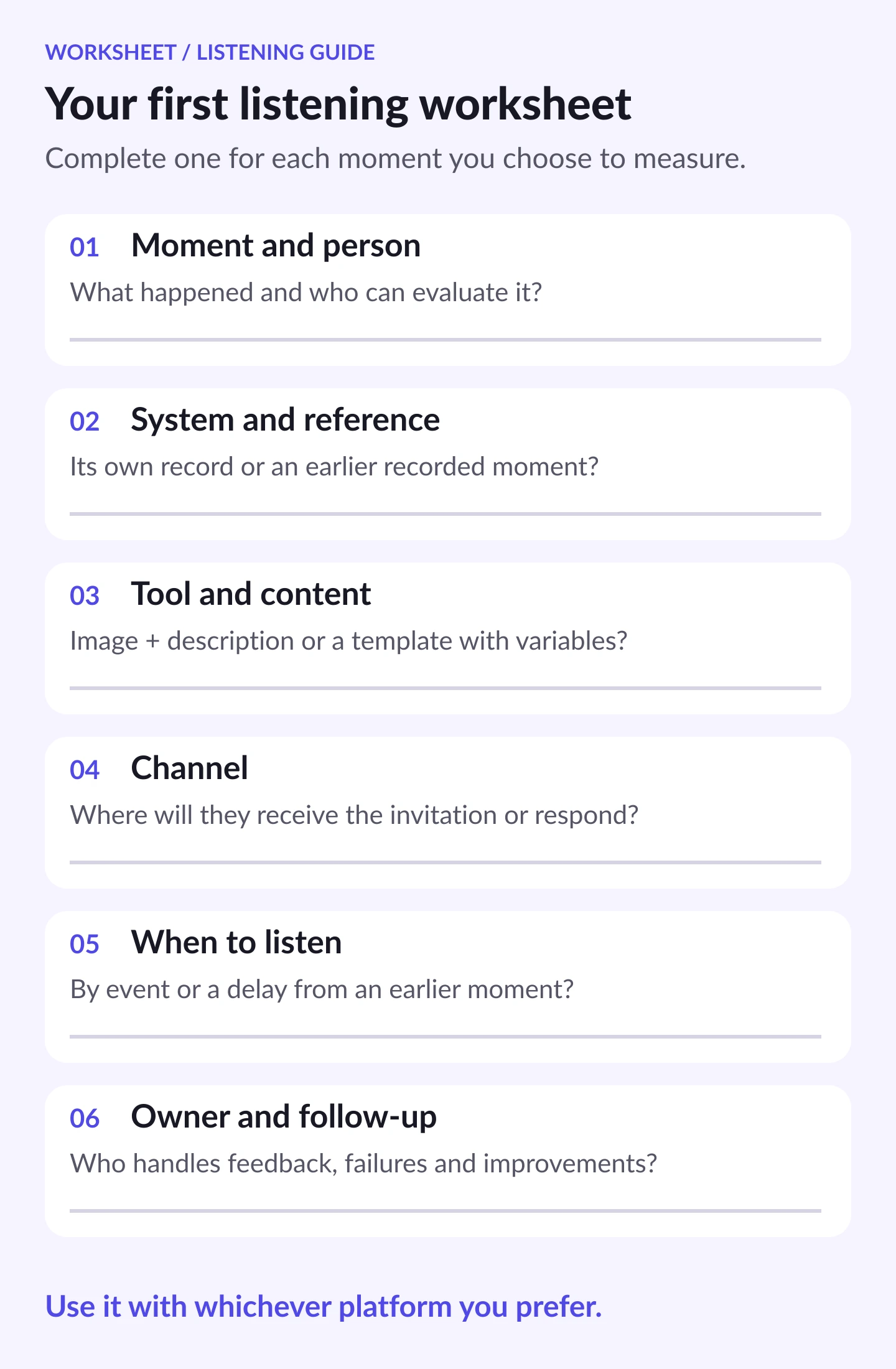
Save the sheet or copy this sheet to a shared document:
- Moment and person: what happened and who experienced it.
- System and reference: where the moment is recorded or what previous recorded moment allows it to be programmed. If there is no reference, resolve it before including it.
- Tool and content: image and description for woku; template with its variables for CSAT, CES or NPS.
- Channel: where the person will receive the invitation or respond.
- When to listen: event that triggers it or deadline from a recorded time. Also agree on the frequency.
- Responsibility and monitoring: who attends to the opinions, reviews flaws and checks for improvements.
Start with a viable moment connected to your record. Check that the invitations go out and that someone is acting on the answers before extending the trip.
A resource for drawing your trip
The free woku trip builder allows you to sort moments and choose what you want to understand without creating an account.
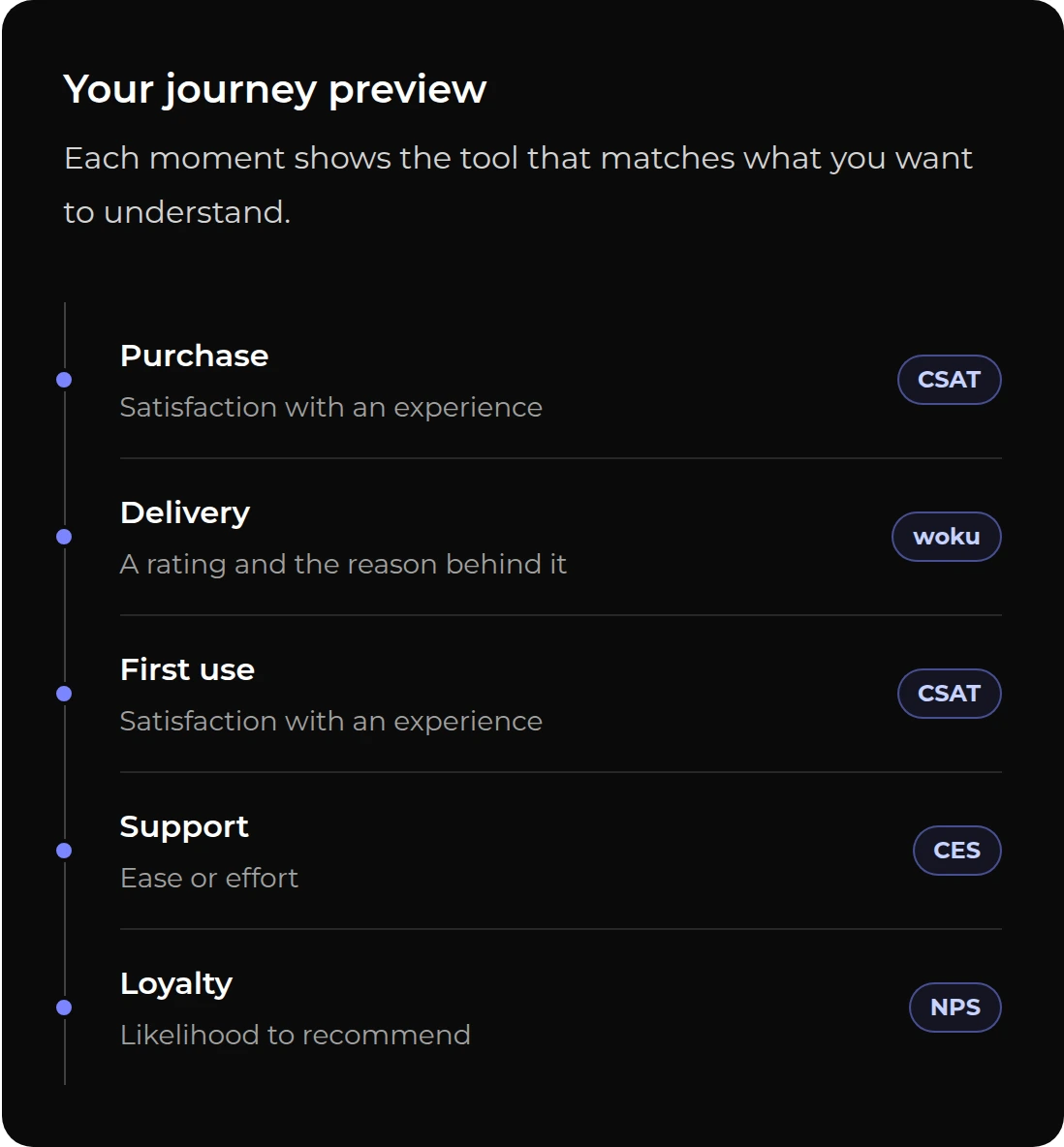
You can generate a public link to share the map. That copy doesn't activate measurements or be saved to a woku account. Use it as a conversation base, complete the source systems and times, and then implement listening with the tools you prefer.
To go deeper: the format of a woku, CSAT, CES and travel, events and programming. The trip and situations in this guide are illustrative examples.