Why do your customers quote, but don't buy? How to find out what's holding back sales


Find out what's holding back a quote and how to ask your customers without assuming that all sales are lost by price.
The quote has a logo, a beautiful cover and twelve pages explaining everything that the service includes.
You checked it three times before sending it. You even fixed that table that always gets messy in the PDF.
The customer answered “thank you, we reviewed it”.
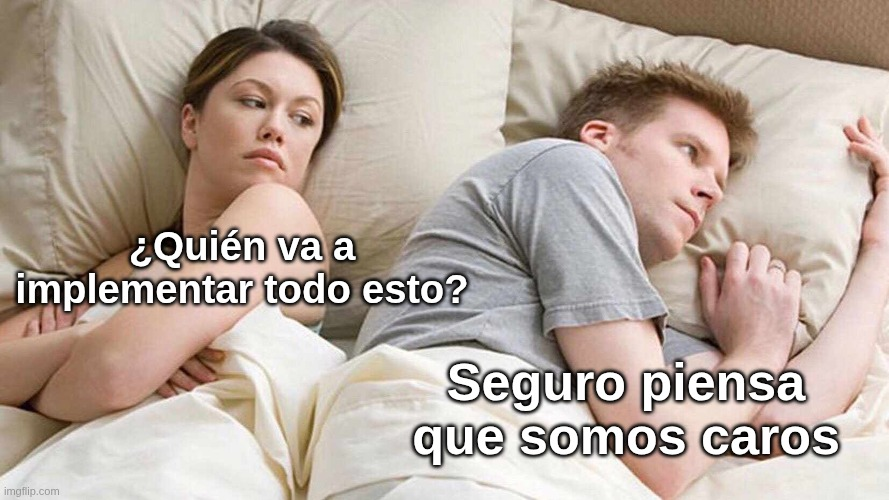
Then you sent a follow-up. And then another one. At some point, the phrase “surely we are expensive” appeared, which has the advantage of explaining any lost sale without having to find out too much.
Let's imagine that on the other side is Camila, who needs to implement the service with a team of two people. He read your proposal and understood the functionalities, but not the work he has to do to get started.
He's worried about hiring something he can't start up. He didn't tell you because he's still comparing and going around with twenty other things.
You're thinking of lowering the price.
She's thinking about who's going to do the trick.
“He stayed to answer” doesn't explain why he didn't buy
When a price does not advance, I would start by distinguishing if the opportunity is still open, if it was postponed or if it was actually lost.
It seems like an obvious difference, but it changes a lot what you should do.
A company waiting for budget approval is not in the same situation as another that has already hired a competitor. Just as someone who asked for information to find out if the project was viable next year is also different. Or even, someone who was just watching, to see something.
Before putting together a theory about your price, I would review what we know and what we're assuming.
“He hasn't responded” is something we know.
“He found us expensive” is a hypothesis, unless he said so. And even when you say so, you should understand what it means: don't you have a budget, don't you see enough value, or are you comparing different scopes?
These are not three ways of saying the same thing. They are three different conversations.
The proposal can be complete and leave out what is important
In Camila's story, there was no shortage of another feature page.
It remained to be answered what his team would have to do, how much support he would receive and what the start would be like. The quote described the service very well, but it didn't allow him to imagine using it. Or if you imagined it, but leaving everything aside...
I would review the proposal from there. What does this person need to resolve in order to decide?
Maybe you want to know if you can start with one branch before hiring for all of them. Maybe you need to understand what's included in the price and what's charged separately. Perhaps his leadership asked him to justify a result that the document doesn't even mention.
You might be able to resolve some questions by adding information. Others need to simplify it. Sending more pages is not the same as explaining better.
In fact, in our example, another list of features would give Camila more things to imagine implementing with her two people, and even thinking about a third one.
I don't know if that would help much.
I would change the tracking before changing the price
“Were you able to review the proposal?” It helps to know if you opened it or not. But it can leave us exactly where we were.
Camila could answer “yes, we're still seeing it” and we would have a new follow-up date. Nothing more.
I would try a question that allows you to put what is missing on the table:
Camila, thinking about what they need to solve, is there anything in the proposal that still doesn't allow them to decide? It could be about the scope, the implementation, or any other questions that remain.
The question doesn't promise a sale. Your job is to open up a more useful conversation.
And if you already chose another option, I would change the approach:
Thank you for letting me know. To understand where we needed to adjust the proposal, what weighed the most on the decision? It helps me to know that even if they've already solved it.
Then comes the difficult part: listening without turning each answer into a new objection that must be overcome.
If she says she needed something that you don't offer, there's no need to convince her that she didn't really need it. Maybe it wasn't a good opportunity for that service.
And if he doesn't respond, he wouldn't invent an explanation for completing the record either. [No answer] can be left as if not answered.
It would save the customer's response, not our favorite translation
Suppose that several people tell why they didn't move forward.
One says that the project was canceled. Another one, which needed to start earlier. Another, who did not understand who would be in charge of the start-up.
If everything ends up being saved as [price], it will be difficult to improve anything.
I would note the confirmed reason, the part of the proposal that raised doubts and if the decision is closed or pending. I would also keep the original comment. Not to put together text by piece, but to be able to check if our interpretation makes sense.
The difference between 'you don't have a budget' and 'you didn't justify the budget' can disappear very quickly within a label.
Then I would compare similar opportunities: same type of customer, similar need and a comparable proposition. Mixing a small purchase with a multi-month tender probably isn't going to shed much light on us.
And I would also look at those who did buy. Understanding what allowed them to decide can be just as useful as understanding what held back the rest of them.
The experience starts before payment
At woku, we talk about listening throughout the customer journey. That tour may include moments before the purchase, such as a visit or a quote.
One way to apply it would be to collect comments after a proposal: if the person could understand the service, what information they lacked and how difficult it was to move forward. Shipping is defined according to the process and the channels that each company has configured.
That doesn't make woku an automated seller or replace commercial tracking. It helps to incorporate the perspective of the person being evaluated, rather than relying only on what the team believes happened.
(For now, don't make AI agents cold call, especially on high-value tickets. Technology isn't that cool yet. )
In Camila's case, that difference is important. “Lack of interest” would lead us to insist. “I don't know how I'm going to implement it” allows us to explain, adjust or recognize that we don't have a suitable solution for it.
Fewer guesswork in the next quote
If you detect a repeated doubt, I would change something specific and then review what happened with new comparable opportunities.
For the example we've been using, I would add a simple start: what the supplier does, what the customer does, and what they need to have ready. Then I would ask if that explanation allowed us to better understand the process.
It wouldn't change the price, the document, the service and all the tracking at the same time. Then it would be quite difficult to know what worked.
You may find that you are indeed out of budget. All right, now you know. You may find that the customer needs another solution. It also works.
And maybe Camila will answer you something much smaller than anything you had imagined:
“Oh, I thought we had to do the implementation ourselves.”
The table in the PDF was perfect.
The missing part was that.