Why don't my customers come back? How to find out the cause and what to do


Why your customers stop buying, how to find out the cause, and what to do before offering another discount.
Imagine that you receive an email from a store where you haven't shopped in months.
The subject reads: “We miss you.”
Below is a discount, a nice photo and a huge button to buy again.
And you think: “I missed them too when I needed them to help me with the order.”
Because the last time the product arrived with a broken part. You wrote, they asked you for photos, you sent the photos and then they asked for your purchase number. The same one that came in the first message. In the end you got the piece on the other hand and went on with your life.
The store doesn't know that last part. Just know that you stopped shopping.
That's why he sends you a discount.
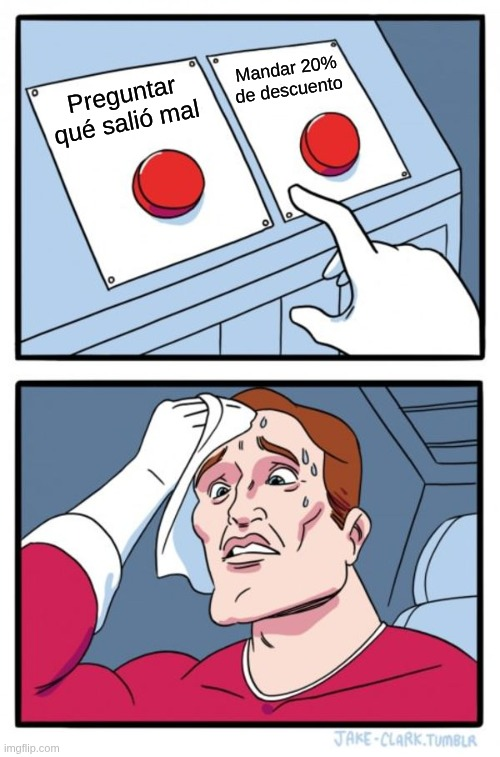
It's not a story about a particular store. It's a way of looking at the question that matters to us: when a customer doesn't return, are we investigating what happened or are we trying to make them come back without understanding anything?
The price is a suspect too comfortable
When an explanation is missing, the price is up to hand.
“I'm sure you found something cheaper.”
It can be. It could also be that you no longer need the product, that you have changed cities, that you are buying less often or that the last experience has taken away the desire to repeat it.
Each possibility asks for a different answer. A person who no longer needs what you are selling will not be recovered by fixing the office. And those who lost trust in the firm may not care much about your coupon.
I wouldn't rule out the price. What you wouldn't do is crown him guilty before asking the customer.
Because something very absurd happens there: we end up charging less for an experience that continues to have the same problem.
First you have to know what “he didn't come back” means
Before looking for lost customers, I would review what a normal repurchase looks like in that business.
Let's say you sell supplies and you have customers who are replenished every week. If you haven't purchased for two months, you deserve a review. But that same time frame doesn't mean much to someone who bought you a dining table.
The table is still there. He's doing his job.
You don't need to invent a dramatic explanation for every absence.
To start, I would separate those who purchased only once from those who already had a frequency. Then I would look at how much time used to pass between purchases and what happened in the last interaction.
Was there a return? Did they ask for help? Did the product you were buying change? Did they have to wait for an answer? Did the service end and there was nothing else to hire?
The idea is to assemble groups that make sense, not to involve everyone in a campaign called “reactivation” and wait for the subject of the email to do the rest.
“He didn't come back” is the result, not the explanation
Let's return to the order with the broken part.
If you only look at sales, you're going to see a purchase and then nothing. If you review the conversation, another story comes up: there was a problem, the customer tried to solve it, and the company lost track.
That's what I would seek to rebuild. What the person expected, what they received, where the difficulty appeared and what the company did next.
And it would leave room for something uncomfortable: perhaps the customer experienced a problem that doesn't appear in any record.
That's why, in addition to looking at data, I would ask him. With a message that sounds like someone trying to understand, not a survey disguised as concern:
Hello, Sofia. We're reviewing what the experience was like after the purchase. Was there anything that didn't work as you expected? It helps me to know that even if you're not thinking of buying again.
I wouldn't immediately accompany it with an offer. If every answer ends in “we just have a promotion”, it's pretty hard to believe that you wanted to hear.
And I wouldn't insist until I got an explanation either. The customer was not hired as a consultant after buying you.
You don't need to get everyone back the same way
Let's imagine that three answers arrive.
A person says that he liked everything, but he still does not need to buy again. Another account that the product didn't work for what you were looking for. The third one says it's still waiting for a return.
The first time I wouldn't invent a problem. The second time I would try to understand what I expected and how I came to choose that product. The third one would resolve the return before talking about the repurchase.
It's quite different from sending them the same “we miss you”.
When you review the answers, keep the customer's words. A category such as “after sales” helps to tidy up, but it doesn't replace context. That word includes everything from a simple question to a full week of pursuing a solution.
Nor would I turn five answers into an explanation about the entire customer base. They are a starting point for research. Those who answered don't automatically speak for those who didn't answer.
Work changes when it's still happening
Researching why someone stopped buying works. But in the example of the broken part, there was an earlier opportunity: to learn that the problem was still open while the customer was still waiting for help.
That's why at woku we work with listening at different times of the trip, not just with an evaluation when everything ended. Purchasing, delivery and post-sales can give you different information.
You don't need to ask everywhere from day one. I would leave for the moment that leaves you with the most doubts today.
If after delivering an order no one knows how the customer went, I would start there. If the greatest uncertainty is after an installation, you would hear when the person had a chance to use what they bought.
The important decision comes along with that listening: who will review a bad experience and what they can do about it.
Because receiving “the part is still broken” and leaving it in storage doesn't fix much either.
The next email may talk about something that did change
After intervening, I would review what happened: if the problem was resolved, if the person was happy with the solution and, where appropriate for their buying cycle, if they returned.
They are different things. Someone thanking you for an answer doesn't prove a repurchase. And the fact that I buy again does not prove, in and of itself, that it was thanks to our intervention.
But you already have something much better than a campaign sent and your fingers crossed.
Above all, you have a chance to change the next message.
Instead of “we miss you”, you could say:
We reviewed what happened with your order. We changed the process so you don't have to send the same background multiple times. Your replacement is already coordinated and this person will follow the case with you.
That doesn't guarantee that the customer will return.
But at least now the company has more than just a discount to offer you.