A team of fast, frictionless tools for measuring CX: woku, CSAT, CES and NPS

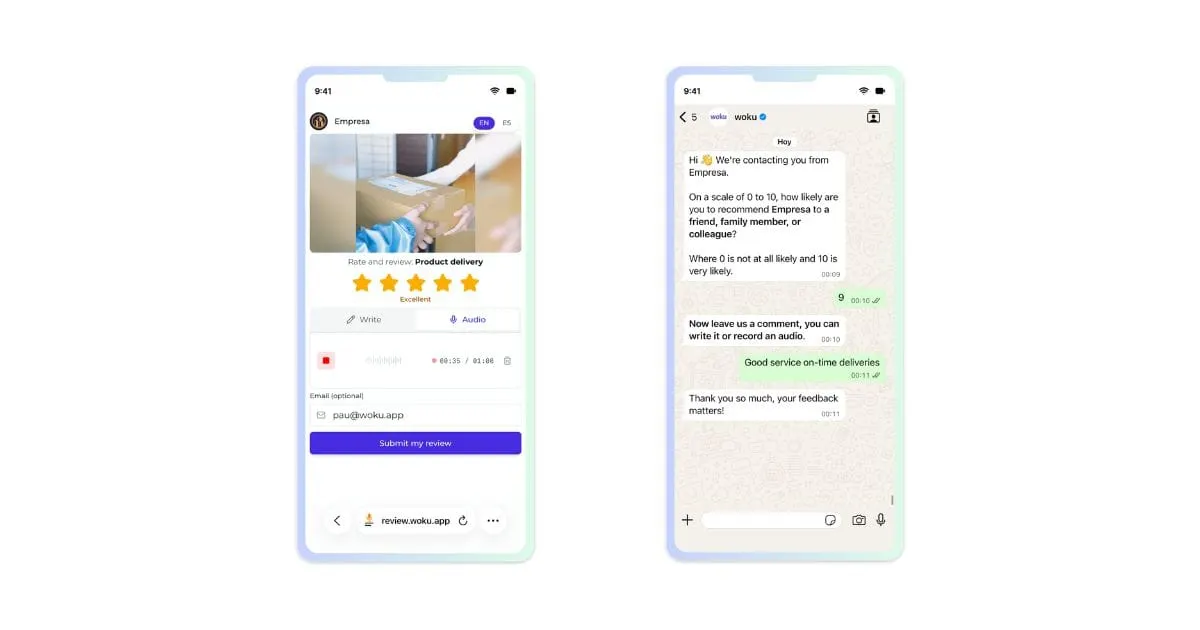
The story of how we stopped believing that a single tool measured the entire experience, and why we added NPS, CSAT and CES without betraying the woku philosophy.
I'm going to confess something that I had a hard time admitting: for a long time I thought the woku was THE ANSWER to measuring the CX. The ultimate tool. The perfect hammer for any nail that was put in front of me.
And when you have a perfect hammer, guess what? Everything is starting to look like a nail to you.
We had a quick, visual tool, without eternal questions, that the customer answered in less than a minute. We had won the match in the traditional polls (we were, say, 2 to 0 up). So my conclusion as an enthusiastic founder was the most natural in the world: if woku measures experience, then woku measures ALL experience.
Spoiler: no.
The moment when the chip fell
A customer's experience isn't a photo. It's a movie.
When someone buys, receives, asks for support, buys again and (hopefully) recommends you, they are not living a moment: they are living several, and each one has their own relevant question. Asking him the same thing, in the same way, at all those moments was like using the hammer to screw. It works, but they look at you strangely.
I didn't make this up for myself while drinking coffee. Lemon and Verhoef describe the customer experience exactly like this: as the result of multiple touchpoints over time and multiple channels (Lemon & Verhoef, 2016). And McKinsey went even further: measuring complete journeys well predicts business results (repurchase, churn, word of mouth) better than measuring single touchpoints (Duncan, Jones & Rawson, 2013).
Translation: it's not about measuring everything, but about measuring well every moment that actually organizes the customer's perception.
My favorite mistake: believing that a metric is “the good one”
Here is the second confession. For a while I also looked for the magic metric. That single number that summarizes the customer's happiness at a glance. It's tempting: a single KPI, a single graph, a single happy committee.
The problem is that that number doesn't exist.
De Haan, Verhoef and Wiesel analyzed 93 companies in 18 industries and came to an uncomfortable conclusion for lovers of the “silver metric”: no metric is superior in all contexts, and combining several predicts better than betting everything on one (de Haan, Verhoef & Wiesel, 2015). That is to say: the problem was not the woku, nor the NPS, nor any particular tool. The problem was my obsession with ONE doing everything.
Every moment has its question
When I stopped fighting with this, the solution appeared almost by itself. I don't need one metric that does everything. I need the right metric at the right time, and that they all inherit the same woku philosophy: fast, visual, frictionless, with the “why” in an optional comment.
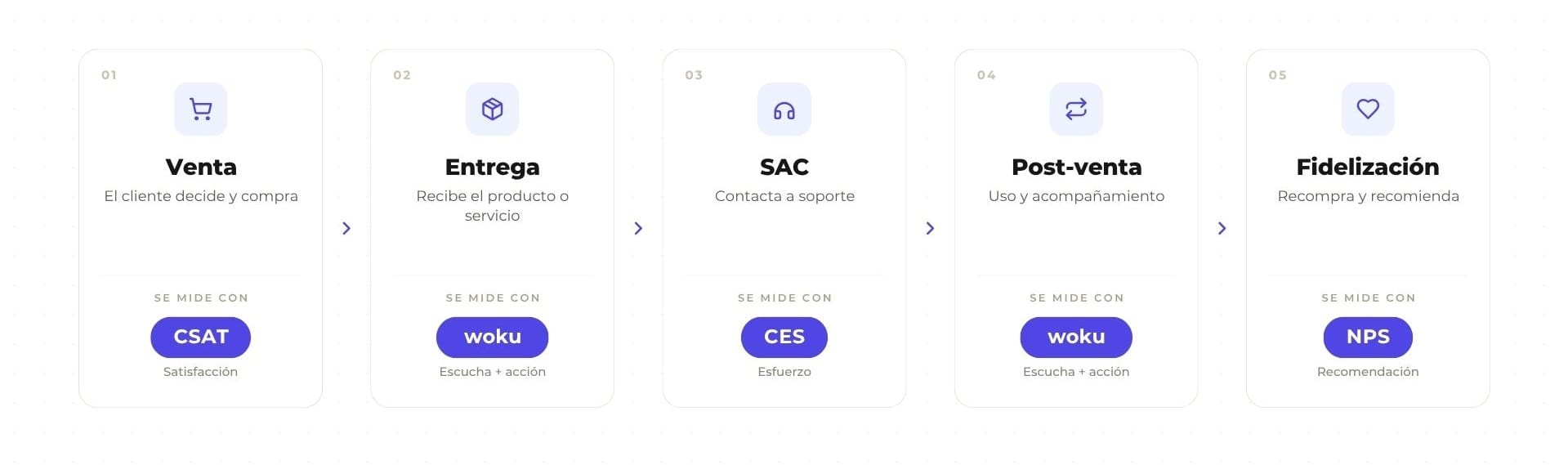
This is how our way of listening to the customer turned out today:
- woku for comprehensive feedback: when I want to know what the customer thinks about a specific moment (an event, a product, an interaction), with stars and a free review. It's listening and acting.
- CSAT for satisfaction: How happy you were right after a key moment, such as the purchase. Short, punctual, instantly.
- CES for the effort: how easy (or how uphill) it was for him to achieve what he came to do. It shines in support and after sales, where reducing friction matters more than “surprising” (Dixon, Freeman & Toman, 2010).
- NPS for loyalty: how likely they are to recommend you. The strategic metric, the long-term metric, that any directory understands instantly.
And in all of them, the open comment is what converts a number into a decision. It is the bridge between the short signal and the root cause (Ordenes et al., 2014).
Notice the beauty of the matter: we don't replace woku with these metrics. We added them together, and they are all still woku in spirit. No 30-minute surveys where 53% drop out halfway (Galesic & Bosnjak, 2009). Each tool asks a little, asks about the time, and asks what is appropriate.
What I Learned Building Woku
Being a founder has this: you fall in love with your product and sometimes you confuse “I love this tool” with “this tool solves everything”. Recognizing that the woku didn't measure all the experience was not to admit a weakness. It was finally understanding what our value proposition really was.
woku has never been “a nicer survey”. woku is short, contextual listening throughout the journey. And for that, a single instrument is not enough: a small set of tools is needed, each one playing in its own position.
woku for comprehensive feedback. CSAT for satisfaction. CES for the effort. NPS for the recommendation. All fast. All without friction. All with the reason just a click away.
References
- by Haan, E., Verhoef, P.C., & Wiesel, T. (2015). The predictive ability of different customer feedback metrics for retention. International Journal of Research in Marketing, 32 (2), 195-206.
- Dixon, M., Freeman, K., & Toman, N. (2010). Stop trying to delight your customers. Harvard Business Review, 88 (7/8), 116-122.
- Duncan, E., Jones, C., & Rawson, A. (2013). The truth about customer experience. McKinsey & Company.
- Galesic, M., & Bosnjak, M. (2009). Effects of questionnaire length on participation and indicators of response quality in a web survey. Public Opinion Quarterly, 73 (2), 349-360.
- Lemon, K.N., & Verhoef, P.C. (2016). Understanding customer experience throughout the customer journey. Journal of Marketing, 80 (6), 69-96.
- Ordenes, F.V., Theodoulidis, B., Burton, J., Gruber, T., & Zaki, M. (2014). Analyzing customer experience feedback using text mining. Journal of Service Research, 17 (3), 278-295.