Three Years Later: What We Learned by Really Listening to Our Customers

How we renewed the woku brand after 3 years of listening to customers: AI, real-time feedback and continuous improvement to make better decisions.
Renewing a brand isn't about changing a logo, choosing a nicer typeface or inventing a phrase that sounds good in a meeting. That's the easy part.
The hard part is to look back and accept that, many times, the market understood your product before you did.
That happened to us at Woku.
We have been building, selling, adjusting and, above all, serving our customers for three years. And along that path, we understood something that today seems obvious, but that wasn't so obvious at the time: woku was never just a tool for showing the good. It was always a tool for improvement.
We started looking at the applause
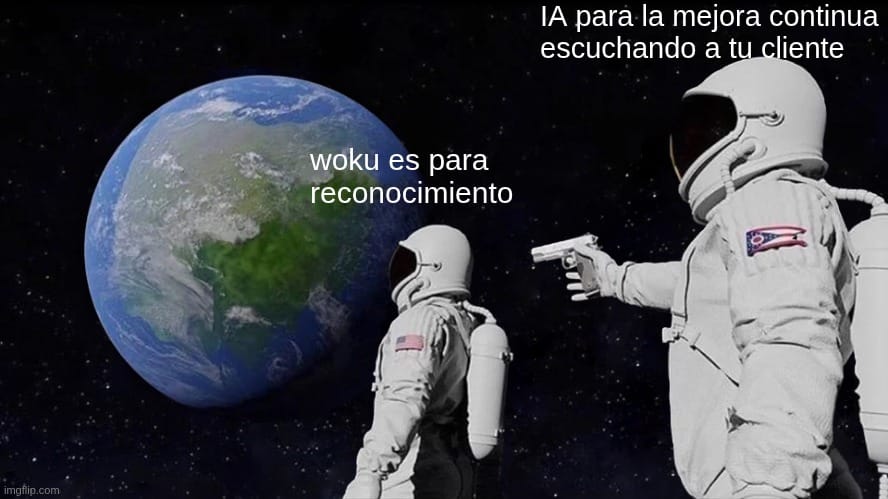
In the first year of woku, between February and September 2023, we presented ourselves as a platform to recognize workers.
The tool was the same as it is today: a woku. A photo that represents what you want to evaluate, a rating of 1 to 5 stars and a comment in text or audio.
Simple. Fast. Direct.
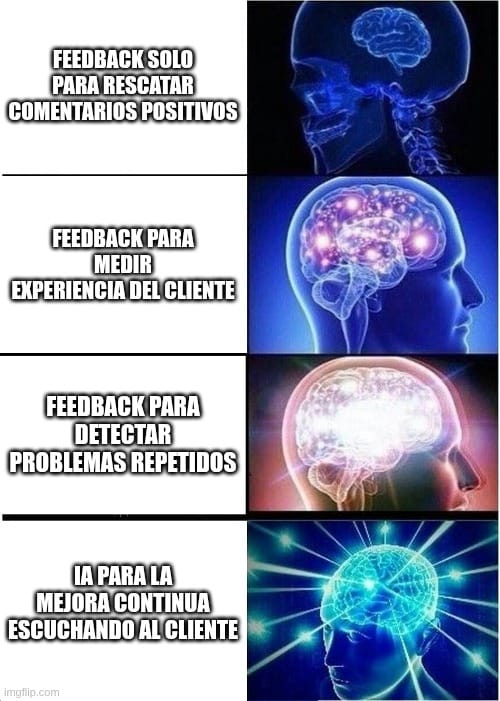
At that stage, our focus was on capturing positive feedback and turning it into visible recognition. The logic was clear: if someone left a good review, that could be transformed into a post for LinkedIn or Instagram. We would take that information ourselves and put together the posts.
It worked, but so far not anymore.
The product worked. The story, not so much.
When the customer occupies your product better than you
In September 2023, something important happened. Ewood, a startup, wanted to use woku to measure feedback from people occupying their scooters.
We weren't growing as expected, so we said yes.
And thank goodness.
There we understood that woku made much more sense when it was not only used to rescue the positive, but also to detect opportunities for improvement. It was very easy to capture feedback. The format was fast. The open field allowed real issues to appear, not forced responses.
You didn't have to push too hard to get people to talk.
You had to listen.
That was one of those awkward but useful moments. The customer was finding more value in the product than we were in our business discourse.
Paula went out to sell and I went out to rebuild
With that clearer signal, Paula decided to go out and sell with much more force. He spoke with more than 300 entrepreneurs and achieved more than 20 sales.
For my part, I ran to do what I had to do: implement a more robust backend and give woku more analysis capacity.
We began to group the wokus into folders according to their homogeneity. And that's where one of the format's most powerful advantages appeared.
Unlike a traditional survey, where mixing a scale of 1 to 5 with multiple-choice questions often ends up in a salad that is difficult to analyze, wokus share a consistent structure. They all have the same format. That makes it much more natural to group them, compare them and read patterns.
That's where I felt the pressure, of course. But I also felt that we were already standing on something more solid.
Seeking feedback to improve products, services and processes made a lot more sense. In sale and in use.
Spoiler: That's probably what it was always for.
We grew, but not all growth works the same
Then came growth, yes, but there was also a classic lesson from the SME world: instability.
There are many good things about working with entrepreneurs, but it also has a hard reality. A lot of businesses just don't follow. The churn was high.
And while that was happening, one of our customers who used woku the most was not an SME. It was RE/MAX Chile.
That was also telling us something.
Then, in June, we started to “fuck” with Inchalam. They met us through MadeInnConce and Hugo, their innovation leader, liked the tool.
That's where another important change began: we began to move towards a more corporate market.
With that came longer, more consultative and much less impulsive sales processes than the typical “I got dyed, let's try” sales processes. It wasn't a market that allowed us to grow at the speed we wanted, but it did allow us to pay salaries and start building with more stability.
At that stage, we began to emerge as a customer experience management software.
And we added NPS.
Our new customers liked it. And it made sense. It was a well-known tool, easy to explain and useful to complement what we were already doing.
The problem with pretty labels
We continue to grow, and in 2025 we enter a more introspective phase as a team.
We continued to serve customers. We were still building. But it was no longer enough to operate. We needed to better understand what our real value was as a tool and what our purpose as a company was.
For a long time we were enemies of polls. With some reason, too. They are often slow, cold, not very actionable and end up buried in a report that no one reads.
But we also understood, thanks to Gonzalo de Colbún, that a survey is not the enemy. It's just another tool.
So today we have them too.
The point wasn't to fight with the format. The point was to understand what each thing is for.
And as we watched our customers use woku, the pattern became more and more evident.
An alert arrives because negative feedback is detected. There is a lack of paper in the bathroom. The alert comes to someone via WhatsApp. It is replenished.
There are several alerts for problems with weight machines. They then review the report, confirm that it is a repeated problem, fix the machines or change them.
At one event, 30% of the comments said that there was a lack of vegetarian variety. In the next event, that is corrected.
These aren't examples invented to sound good in marketing. These are real cases of our clients.
And there we understood something very important: what woku generates is not just “CX management”, at least not in the elegant and corporate sense of the term. What it generates are specific, granular, concrete improvements. Small adjustments that change customer perception because they solve real problems.
You don't always need a great strategy. Sometimes it's enough just to have paper in the bathroom.
The truth doesn't always come from branding
In this process, we teamed up with Andrés Galindo, from HolaYunta and IncuBaudec's mentor, to work on how we were communicating woku.
And there he made us a key recommendation: find the truth, the promise, the purpose and the slogan of the brand.
Not to sound prettier.
To sound more honest.
After all this journey, that's what we found.
The Truth About Woku
AI for continuous improvement by listening to your customer.
We say AI because yes, we use AI. And not as an ornament. We use it to accelerate analysis, automate processes and make life easier for the customer.
We say continuous improvement because that's what we saw in practice. woku doesn't show up once a year for a big solemn report that someone will probably look at with a worried face and then archive. Woku is used to always improve: processes, services, products, operations.
And that improvement is born by listening to the customer. Not guessing it. Not assuming. Listening to it.
The Woku Promise
We measure the feedback from your customers so that you can make better decisions.
There's not much mystery here.
We capture feedback in text or audio, sort it, analyze it and make it useful for making decisions.
That is the promise. That deciding doesn't depend on late intuition or problems that exploit you when it's too late.
The purpose of woku
We exist so that no business loses a customer because of something they didn't know.
This comes more from wadding.
Paula and I have been entrepreneurial, we have been on the other side and we know what it means to find out late. A small problem ignored in time quickly turns into a leak, complaint, bad experience or wear and tear.
If we can help a business find out sooner, can fix it and not lose a customer due to a pure lack of visibility, then we are building something that really matters.
The slogan
Listen in time, decide better.
Because that sums it all up.
If you listen in time, you can still act. And if you act with real information, you can correct, retain and improve the relationship with your customers.
It's not just a short phrase. It's the complete logic of the product.
What we are really renewing
Yes, we are renewing the woku brand.
But deep down we are not changing who we are. We are, at last, saying better what was always happening.
During these three years, we learned that our product does not live in theory or in the fashion category that we put on top of it. It lives in what our customers do with it.
And what they do is use feedback to improve.
Sometimes to correct something small. Sometimes to detect a pattern. Sometimes to make bigger decisions.
But always to act.
If these years left us anything, it wasn't just a better brand. It was a clearer idea.
Woku exists to help you listen before it's too late.
And if you do that right, a lot of things get better later.