Reflection on the Use of Extended Language Models (LLMs) in the Analysis of Comments in eCommerce and the Potential of GPT-4o

Discover how Extended Language Models (LLMs) are transforming comment analysis in eCommerce and how woku, with the power of GPT-4o, is bringing these capabilities to industries such as education, consulting and manufacturing.
E-commerce is facing an increasing challenge: how to understand and act on the vast volume of customer comments and reviews. As e-commerce grows, so does the need for more sophisticated tools to analyze this data. This is where Extended Language Models (LLMs) come into play, which have revolutionized sentiment analysis by offering a deeper and more nuanced understanding of customer views.
The role of LLMs in eCommerce
Traditional sentiment analysis methods, based on keyword matching or simple machine learning algorithms, have proven to be insufficient to capture the complexity of human language. These methods often fail to understand the context, emotional subtleties, and various expressions that customers use in their comments. LLMs, such as GPT-3.5 and LLama-2, have proven to be a significant improvement in this regard. Not only can these models better understand the text in a variety of contexts, but they can also distinguish between complex emotions and multiple intentions within the same review (Tanvir and Torralba, in review) (Wasif and Pearl, in review).
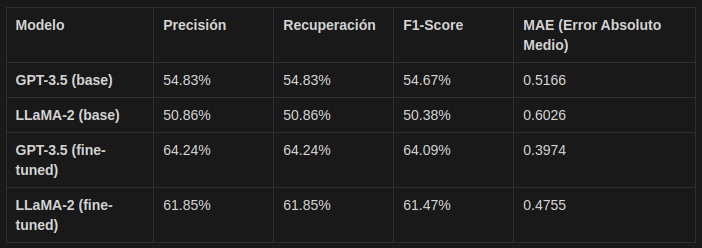
For example, GPT-3.5, after being tuned, showed a notable improvement in the accuracy of sentiment analysis, surpassing LLama-2 in most key metrics, such as accuracy, recall, and F1-score (Tanvir and Torralba, under review). However, both models face limitations when it comes to handling multiple modalities, such as audio and image, and in processing efficiency, especially in multilingual contexts (Tanvir and Torralba, in review).
◆ Despite these advances, there are still areas for improvement, especially when it comes to the integration of these technologies in real time and in applications that require the understanding of multiple data modalities. This is where GPT-4o introduces true innovation.3,4
How GPT-4o revolutionizes sentiment analysis*
GPT-4o, the latest addition to the OpenAI model family, represents a qualitative leap in sentiment analysis for eCommerce. Not only does this model retain the advanced capabilities of its predecessors, such as GPT-3.5 and LLama-2, but it also adds new functionalities that expand its applicability and efficiency'
- Integrated Multimodality: Unlike previous models, which focus primarily on text, GPT-4o is a truly multimodal model that can process and generate text, audio and images in a single architecture. This means that it can analyze not only written comments, but also feedback in video or audio format, capturing a wider range of emotions and nuances (OpenAI, 2024).
- Speed and Efficiency: One of the most outstanding features of GPT-4o is its speed. It can respond to audio inputs in as little as 232 milliseconds, which is comparable to human response time in a conversation. In addition, it is 50% cheaper and offers improved efficiency in the tokenization of multiple languages, making it ideal for companies that operate globally (OpenAI, 2024).
- Multilingual Accuracy: GPT-4o significantly improves analysis capacity in non-English languages, reducing the number of tokens needed to process text in different languages. This capability is essential for companies seeking to understand customer feedback in diverse markets (OpenAI, 2024).
- Generating Actionable Stories and Insights: Beyond sentiment analysis, GPT-4o is capable of generating responses in JSON format, which can be used to create detailed reports that provide a clear and actionable view of the feedback received. This is particularly useful for companies that need to make quick decisions based on real-time data.3,4
Expanding the use of LLMs beyond eCommerce with woku
At woku, we have understood that the advanced capabilities of LLMs, and in particular of GPT-4o, can be extended beyond e-commerce to benefit a variety of industries. Our goal is to bring this technology to sectors such as education, consulting, events and industry, where data analysis and feedback are equally crucial.3,4
Universities
Educational institutions can greatly benefit from the analysis capabilities offered by woku. For example, by analyzing student feedback or course evaluations, woku can identify recurring patterns and themes, providing administrators with a detailed view of areas that require improvement.
Consultants
Consultants that work with corporate clients can use woku to analyze their client feedback in a deeper and more detailed way, allowing the identification of critical points and the optimization of their services. Woku's ability to handle multiple languages and formats ensures that global consultancies can provide accurate recommendations based on up-to-date data.
Events
In the event industry, real-time feedback is essential for measuring success and making adjustments during the event. woku allows organizers to analyze attendee feedback in real time, adjusting logistics and services to maximize satisfaction.
Industry 3,4
In the industrial sector, where feedback from employees and customers on the quality of products and services is essential, woku can generate reports that not only identify problems, but also suggest practical solutions based on detailed analysis.
Implementation in Woku: From Data to Reports↓
At woku, we use LLMs to transform data into meaningful stories. This is possible thanks to the advanced capabilities of GPT-4o, which not only analyzes data, but also generates detailed reports in JSON format, allowing users to view information in a clear and actionable way. This ability to generate stories from data is key to helping our customers make informed decisions and improve their operations.
Final Thoughts↓
Extended Language Models, such as GPT-4o, are redefining the way in which companies can analyze and act on customer feedback. At woku, we are committed to expanding these capabilities beyond e-commerce, providing industries such as education, consulting, events and industry with the ability to transform data into actionable stories. By adopting advanced technologies such as GPT-4o, we enable our customers not only to better understand their data, but also to make informed decisions that drive continuous improvement and sustainable growth.3,4
This approach places woku at the forefront of technological innovation, ensuring that our customers are always one step ahead, ready to face the challenges of a constantly evolving market with the most advanced tools at their disposal.
References 3,4
- OpenAI. (2024). Hello GPT-4o. OpenAI. https://openai.com/index/hello-gpt-4o/
- Roumeliotis, K.I., Tselikas, N.D., & Nasiopoulos, D.K. (2024). LLMs in e-commerce: a comparative analysis of GPT and LLama models in product review evaluation. Natural Language Processing Journal, 6, 100056.
- Tanvir, M., & Torralba, A. (under review). Revolutionizing E-commerce Feedback: Advanced Sentiment Analysis with LLMs.
- Wasif, R., & Pearl, J. (under review). LLM-Enhanced Sentiment Analysis in E-commerce: A Deep Learning Approach to Customer Feedback.