Surveys: A Measurement System That Leaves CX Leaders Unsatisfied


Traditional CX surveys no longer satisfy leaders. A McKinsey study reveals why and what is failing to measure customer experience with these systems.
Paula, the CEO of woku, is very active on LinkedIn. In a recent publication, he stated that traditional surveys are no longer useful. Therefore, a LinkedIn user commented that he was surprised by this statement, since 70% of the CX measurement industry is based on surveys. The truth is that something that is widely used doesn't mean that it's the best.
This led me to research executive satisfaction with survey systems to measure CX (Customer Experience). A study led by McKinsey & Company in collaboration with AlphaSights and Gerson Lehrman Group, paradoxically conducted through a survey, studied more than 260 CX leaders. The results were overwhelming: 93% say they use surveys as their main means of measuring CX performance, but only 15% are satisfied with the form of measurement, and only 6% consider that these surveys serve to make tactical and strategic decisions.↻
What's going wrong with the polls?
The McKinsey report details four clear problems with the survey systems that many companies still use:
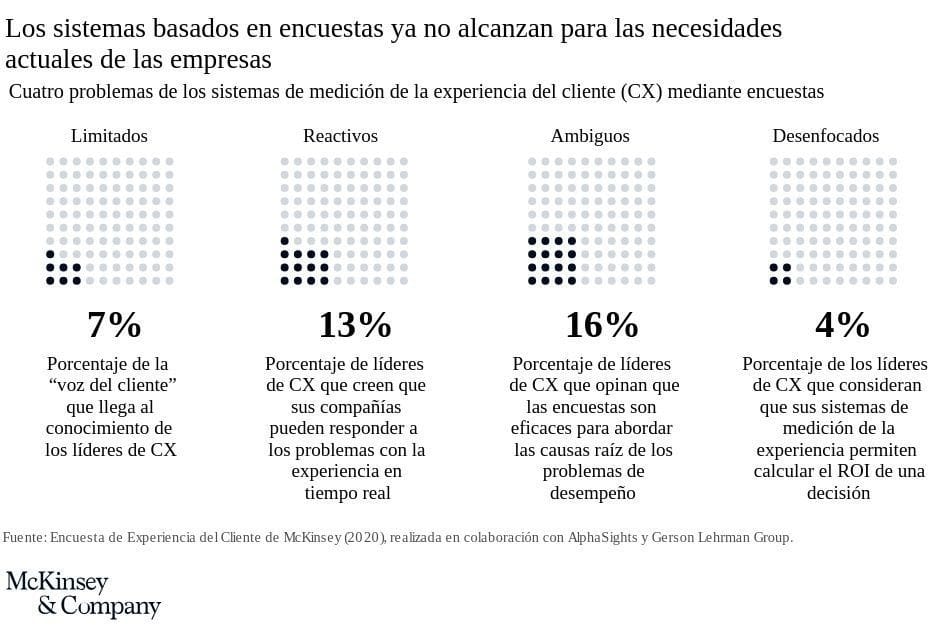
- Limited: They only capture a small fraction of the customer experience, leaving out a large percentage of valuable data.
- Reactive: They respond to problems when it's too late to correct them in real time.
- Ambiguous: They don't help to understand the root causes of problems, making it difficult to take concrete action.
- Unfocused: They don't connect directly to financial results or return on investment (ROI), weakening their strategic value.↻
New ways of doing things¹
It is necessary to reinvent long and eternal surveys. These often contain biased questions that, although some experts consider validated, are far from reflecting reality. For this reason, at woku we have created a simple tool that, with an open field, allows customers to give feedback in real time at any time during the customer journey. We don't ask questions, so there's no cognitive effort on the part of the customer to offer their opinion; they can simply express what they think via audio or text in less than two minutes, without leaving their experience.
References
- Diebner, R., Malfara, D., Neher, K., Thompson, M., & Vancauwenberghe, M. (2021). Prediction: The Future of Customer Experience. McKinsey & Company. https://www.mckinsey.com/capabilities/growth-marketing-and-sales/our-insights/prediction-the-future-of-cx/es-CL#/ ÷