The Union of Two Personalities Brought Life to Woku

Have you ever wondered how an innovative idea was born? This post reveals the story behind the creation of woku. Discover how the unique combination of two different personalities, together with years of experience in entrepreneurship, created a solution that challenges established norms in collecting feedback.
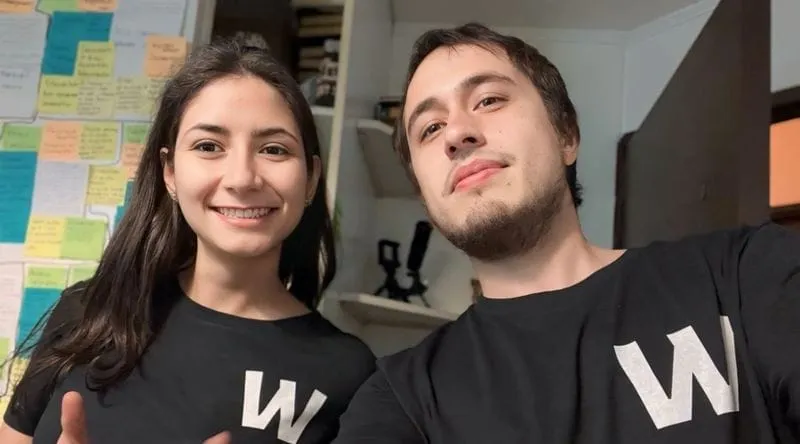
As the technical co-founder of woku, I would like to share how the fusion of our personalities and experiences brought woku, our CX tool, to life. My co-founder, Paula, is a sweet and observant person with a natural inclination towards the visual, while I am pragmatic and direct, with a minimalist results-oriented approach.
The Creativity Systems Model: Our Story Through Three Lenses÷
The renowned psychologist Mihaly Csikszentmihalyi proposes in his book “The Systems Model of Creativity” that innovation emerges from the interaction of three elements: the individual, the domain and the field. The story of woku can be seen under these three elements.
The Individual: The Synergy of Our Personalities*
Paula and I met more than eight years ago in the world of entrepreneurship. Since 2020, our constant collaboration has led to a unique fusion of our strengths. For the same reason, we have acquired (copied) strengths from each other. Paula has become more direct and results-oriented, while I have learned to appreciate and incorporate visual thinking into my work.↑
This combination of my pragmatism and Paula's visual creativity created the perfect context for innovation. As Csikszentmihalyi suggests, creativity emerges when individuals' unique abilities interact with their environment.3,4
The Domain: Navigating the World of Entrepreneurship and Feedback
Our previous experiences in entrepreneurship, including some failures, provided us with a deep understanding of the domain. We learned that traditional surveys are ineffective in truly understanding customers, and that interviews, while valuable, are difficult to systematize.
This domain knowledge, as Csikszentmihalyi points out, is crucial for innovation. It allowed us to identify an unmet need in the market: a way to capture feedback that was as rich as an interview, but as systematic as a survey.⦁
The Field: Challenging Established Norms*
The “field” in the Csikszentmihalyi model refers to established experts and practices in an area. In our case, we were inspired by the customer journey, by my experience using methodologies such as Service Blueprint, and by the collection of feedback as Amazon or Mercado Libre does, with stars and a free field.⦁
Instead of extensive surveys or lengthy interviews, we think of woku as a tool that captures the essence of customers' language at critical moments in their experience, quickly and visually.
Instead of questions, we would use an image or video plus a name. This is often what we see in an e-commerce when they ask us to leave a review. The customer then rates from 1 to 5 stars and leaves a review in text or audio. This tool would be inserted at key moments of the experience to capture the thoughts of customers as if we were doing an interview.⦁
Modeled creatitivity↑
The creation of woku perfectly exemplifies how creativity, according to Csikszentmihalyi, is not just an individual mental process, but the result of the interaction between thought and a larger sociocultural context.↑
Woku was born from the fusion of:
- Our individual abilities and perspectives (the individual).
- Our in-depth knowledge of the market and customer needs (the domain).
- Our willingness to challenge established feedback collection practices (the field).
The result is a tool that combines the simplicity and efficiency that I value, with the visuality and intuition that Paula provides. It's a solution that allows customers to express themselves freely, capturing rich and actionable information in a systematic way.
A Testimony to Systemic Creativeny*
The story of woku is a testament to how innovation emerges from the complex interaction between individuals, their domain of experience and the wider field in which they operate. It's the product of our personalities, our shared experiences, the context of the current market, and the identified need in customers.
Thus, woku isn't just a tool; it's the tangible manifestation of a systemic creative process, a bridge between pragmatism and intuition, designed to revolutionize the way companies understand and respond to their customers.↑
References↓
- Csikszentmihalyi, M. (2014). The systems model of creativity: The collected works of Mihaly Csikszentmihalyi. Springer.