The Importance of Seeking Alternatives to Conventional Surveys


Find out why traditional surveys are full of errors and how woku offers a faster and more effective alternative for collecting feedback. Save time and get accurate results without complications.
Surveys have been a key tool for gathering opinions and making decisions. However, as the study on the “Total Survey Error” (Groves & Lyberg, 2010) points out, traditional surveys have significant problems that can affect the quality of the data we obtain. These problems range from sampling errors and lack of responses to biases introduced by those who conduct and respond to surveys. That's why it's important to reconsider the use of these traditional methods and explore innovative alternatives such as those offered by woku, where asking for an opinion is as simple as using a name and a photo.
Survey Mistakes: Understanding the Issue*
The concept of “Total Survey Error” refers to all types of errors that can arise when conducting a survey. These errors fall into two main categories: observational errors and non-observational errors.
- Observational errors: These occur when the answers obtained do not reflect reality. For example, if a question is poorly worded, the respondent may not understand it well and give an inaccurate answer. Imagine being asked: “How often do you rarely use your mobile phone?” The question is confusing, and could lead to inconsistent answers.
- Non-observation errors: These errors occur when information is not collected from the entire target population. For example, if you only survey people over 60 years of age, but you want to know the opinion of the entire population, the results will not represent younger people.
Limitations of traditional surveys÷
Conventional surveys have several problems. One of the biggest is that they are complicated to design properly. According to Groves and Lyberg, trying to reduce all possible errors in a survey can be very costly and difficult. In addition, traditional surveys often fail to consider other important aspects such as relevance and ease of access to information. This can make the data collected not useful or does not reflect what people really think.
For example, if you take a survey about exercise habits using a very long and complicated form, many people may decide not to complete it, leaving out valuable information. In addition, if the questions are very technical, participants may not understand them and give answers that are not accurate.
We discovered these limitations in conversation with our customers. In many cases, before using woku, they didn't realize the time they spent designing the surveys and finding the perfect questions. This often led to confusion and delays in sending surveys, resulting in the loss of valuable information that could have been obtained at the time. But what was really worrying was the time it took for them to analyze the data: in most cases, it took months, and in some companies, up to a year.
Woku: A Simpler and More Effective Alternative÷
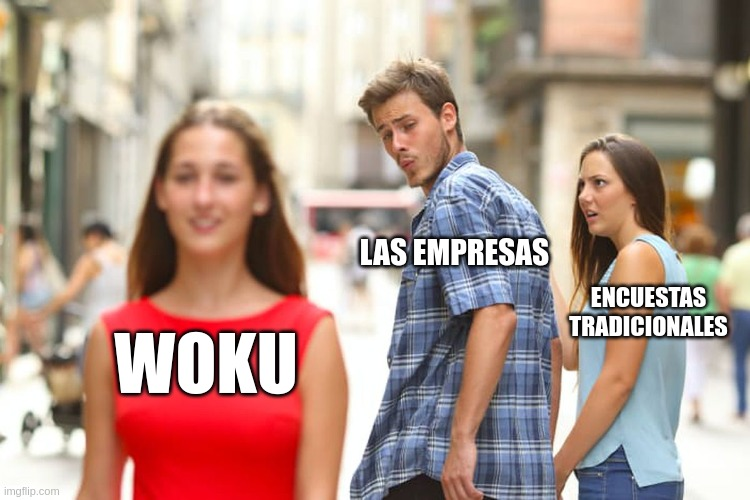
This is where woku comes into play as an innovative solution. Instead of using complicated questions, woku simplifies the entire process. Using just a name and a photo or video, woku allows people to leave a quick rating and a brief review. Not only does this method make it easier for people to participate, but it also reduces the chance of making design errors and the risk of non-response.
For example, instead of asking someone to complete a 10-question questionnaire about a product, woku asks the user to look at a photo and leave a rating of 1 to 5 stars. Then, they add a short commentary in text or audio if they wish; the process takes less than 2 minutes. This simplicity means that more people are participating and the data collected is more reliable.
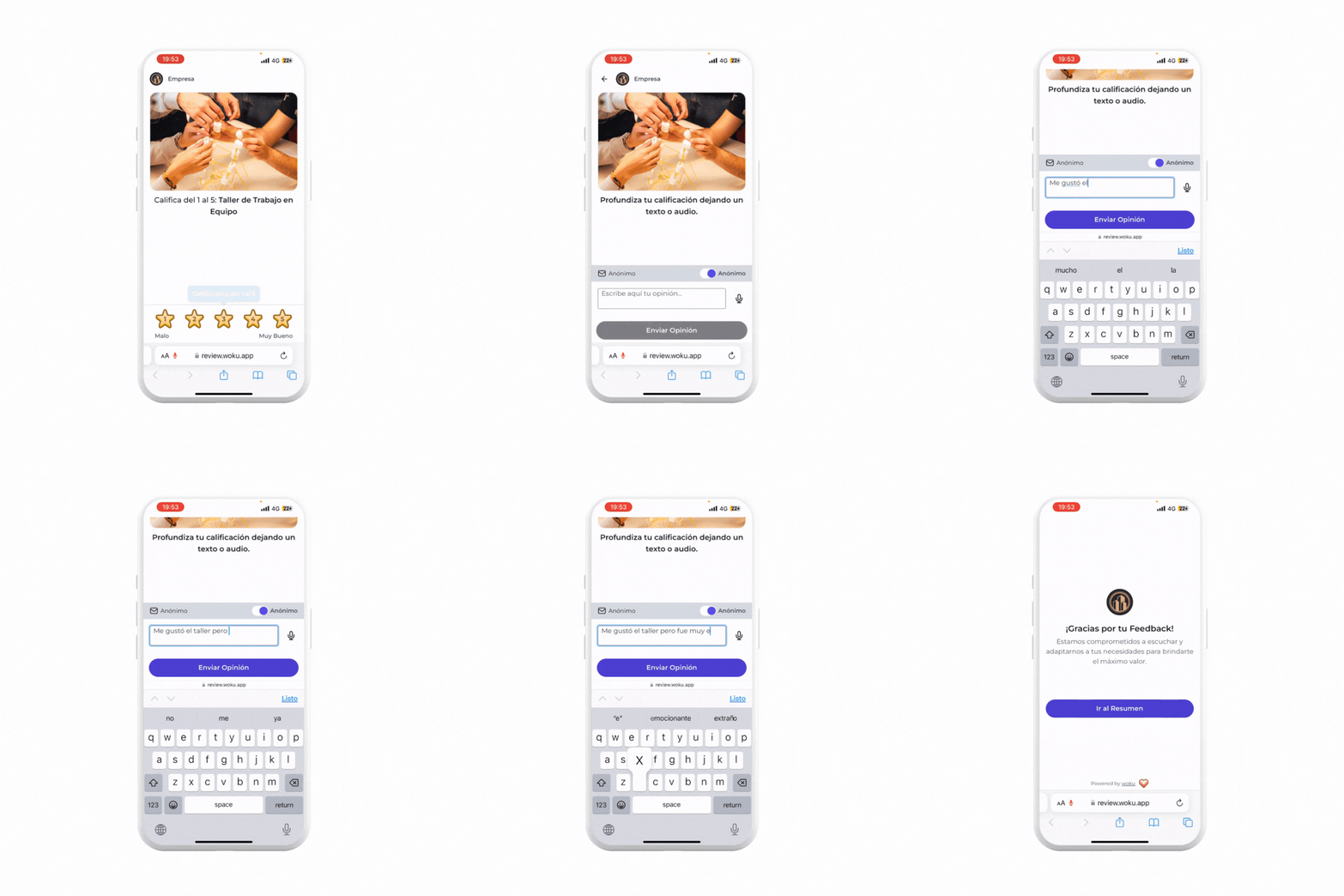
◆ In woku, the problem of delay in data analysis is solved by means of a standard instrument design. While traditional surveys may vary in the number of questions and their format, a woku is always an open field that invites us to comment on the representation of a product, service or process. This allows woku to use a hierarchical ordering algorithm to create reports at different levels of the business. In addition, with the help of artificial intelligence, woku processes data with a simple click, significantly reducing analysis times. With woku, reports are generated in a matter of minutes, and even seconds.
Reflecting on the future of surveying¹
Traditional surveys have been useful, but they have many limitations that we cannot ignore. By exploring new ways of gathering opinions, such as the one offered by woku, we can significantly improve data quality and, therefore, make better decisions. woku allows for more inclusive and accurate data collection, capturing the true voice of people without the problems inherent in traditional surveying.
References
- Groves, R.M., & Lyberg, L. (2010). Total survey error: Past, present, and future. Public opinion quarterly, 74 (5), 849-879.