The retention economy: listening costs pennies, losing a customer doesn't

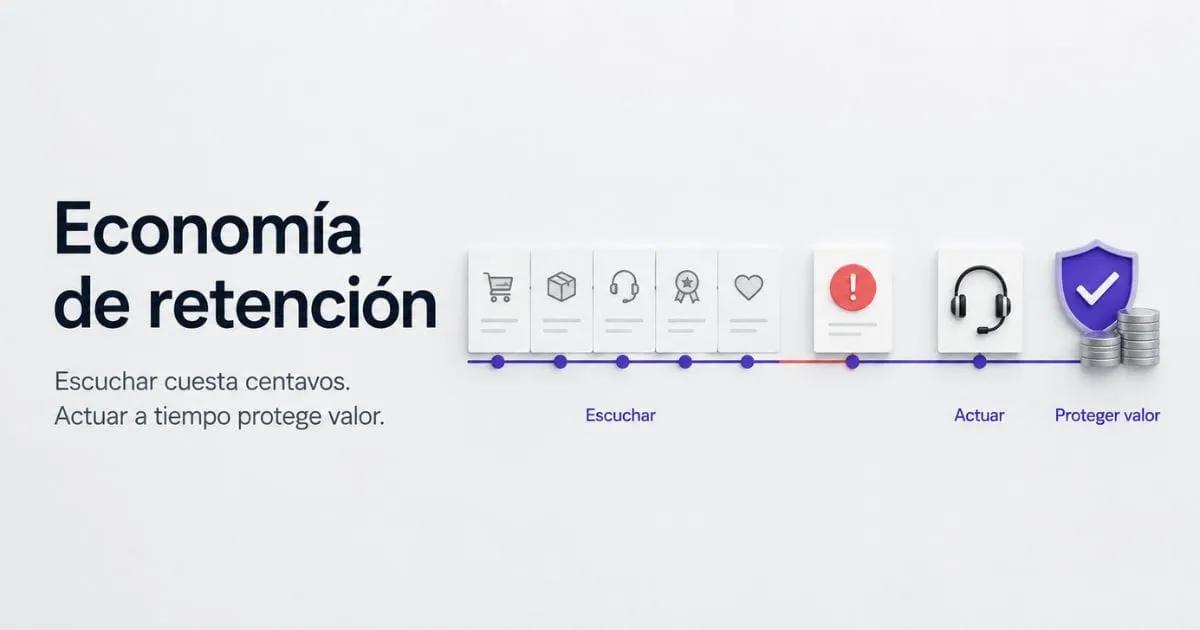
A simple model for calculating how much it costs to listen to a customer during their trip, address a problem on time and protect the value that is still at stake.
We were putting together a slide to explain the value of woku and something quite typical happened to us.
We started talking about customer experience, feedback, artificial intelligence, alerts, support tickets, continuous improvement and revenue protection.
All right.
Also all a bit hazy.
Until a rather less elegant, but much more useful question appeared:
How much does it really cost to listen to a customer?
Not how much it costs to “do CX”.
Not how much it costs to have a strategy with a nice name.
How much it costs to give every customer the opportunity to tell you that something went wrong, before they just leave.
So we did something revolutionary for the world of customer experience: We opened the calculator.

The customer experience must also close in Excel
At CX we talk a lot about satisfaction, recommendation, loyalty and loyalty. These are important concepts, but they have a small problem: sometimes they fall too far from the business. When it's time to approve a budget, someone ends up asking the uncomfortable question:
Yes, but how much does it cost us and what do we protect with this?
And that's fine.
If we say that listening to the customer helps protect revenues, we should also be able to explain how much it costs to generate that protection. We are calling this way of looking at the problem a retention economy.
We didn't invent retention.
We didn't invent Excel either.
We're just trying to bring them together.
Five moments not to find out late
Let's imagine a relatively simple customer journey.
A person:
- purchase
- receive the product or service
- Request support
- Long live the aftermarket
- enter a loyalty or repurchase phase
Not every business has exactly five moments. Some have three. Others have fifteen and probably a diagram that no one dares to touch.
But five are good for this exercise. In each of these moments, there is an opportunity to listen.
- After the sale you can measure satisfaction.
- After delivery, you can ask how the product arrived.
- After support, you can measure how much effort the customer had to put in.
- In the aftermarket you can detect problems with use.
- And before a repurchase you can understand if the relationship is still healthy or is quietly breaking up.
The idea isn't to ask him everything, all the time. The idea is to listen at times when you can still do something.
The Strange Mathematics of Half an Opinion
To do the calculation I'm going to use a 10% response rate. Not because 10% is a universal industry law.
It's not.
The answer changes depending on the channel, the time, the relationship with the brand, the extent of the interaction and the customer's desire to talk to you that day. But we need a scenario to start with.
If we listen in five moments and 10% answer, we get:
5 moments × 10% response = 0.5 reviews per customer.
Obviously, a customer cannot leave half an opinion.
We don't have that feature yet.
But if we do the same exercise with 100 clients, the math is better understood:
100 customers × 5 moments = 500 listening opportunities.
With a 10% response, we would receive approximately 50 reviews.
In woku's lower-volume annual plan, if we were to assign the entire price of the subscription to the quota of opinions, each one represents about $0.20.
In Scale, that value drops to approximately $0.13.
So:
50 reviews × $0.20 = approximately $10.
Divided by 100 customers:
Listening to five moments of the trip costs, on average, less than $0.10 per customer.
That was the first surprise.
We're not talking about ten dollars. Not even a dollar. We're talking less than ten cents to open up five listening opportunities during an entire trip.
In order not to cheat with the calculation: this represents the expected cost of the captured opinions.
When the problem appears
Now comes the second part.
Let's say one of those customers leaves a negative review.
- The product arrived damaged.
- The service was not delivered as expected.
- No one answered your request.
- They charged him something that didn't apply.
The problem already exists. The opinion only makes it stop being hidden.
With woku, that signal can be analyzed by AI and converted into an alert, a support ticket or an improvement action for someone to intervene while there is still time.
For the exercise, let's allocate $5 to the human effort needed to address the case. It can be a call, background checks, coordinating a solution, following up, or simply apologizing accordingly.
So we have:
$0.20 for the opinion + $5 for care = $5.20.
That's the cost of detecting and addressing a rescue opportunity in this scenario.
And here I need to make an important clarification.
$5.20 doesn't buy a withholding
It would be nice to say:
With $5.20 you retain a customer.
It would also be wrong.
Serving a person doesn't automatically mean they'll stay. The problem may be too serious. The solution may be late. The customer may have already decided to switch. Or maybe he never really intended to leave.
That's why $5.20 isn't the cost of a retained customer.
They are the cost of having and executing a rescue opportunity.
The actual cost per customer retained is obtained later, when you can measure how many cases served ended up producing incremental retention.
It's less sexy than saying “hold customers for five dollars”.
But it's a lot more honest.
And in the long run, honesty also sells.
The feedback didn't create the problem
There is another important thing.
When a negative review generates a ticket, it may seem like listening to the customer created more work for support.
It wasn't like that.
- The order had already arrived broken.
- The process was already confusing.
- The attention had already been poor.
- The customer was already frustrated.
woku didn't create the problem. It made it visible.
And making it visible early changes something important: you can still act.
When you don't listen, the cost seems to be zero because no one opened a ticket.
But the account may later appear as a cancellation, discount, return, poor public review, loss of repurchase, or a recommendation that never occurred.
Doing nothing also comes at a cost. It just usually comes without a nice notification.
Let's put it next to the entrance
Let's go back to the calculator.
Let's say a customer generates $500 during that trip.
In our scenario:
Listening to it for five moments costs about $0.10.
That equates to approximately 0.02% of income.
If a problem appears and it costs $5.20 to treat it, that rescue opportunity represents about 1% of income.
Now let's suppose that the business has a margin of 10%.
Of the $500 in income, there would be $50 in margin.
The $5.20 of intervention would be equivalent to 10.4% of that margin.
And here comes a much more useful question than “is it expensive or cheap?” :
What are the chances that acting on time will protect that $50?
If the actual margin at risk is $50, the intervention reaches its breakeven point with a probability of recovery just over 10%.
In other words: if we manage to protect more than one in ten cases that were actually at risk, the exercise begins to close.
And that's just consider a trip.
If the customer can buy again for months or years, the value at stake can be much higher.
So what is the retention economy?
The retention economy is a way of giving numbers to three things:
How much it costs to listen.
How much it costs to act.
How much value can be preserved if the company intervenes in time.
In its simplest version:
Expected listening cost = moments of listening × response rate × cost per opinion.
After:
Cost of intervention = cost of the opinion + cost of dealing with the case.
And finally:
Protected expected value = incremental probability of retention × future margin at risk.
It's not a magic formula.
It's a model.
Every company has to replace our examples with their own data: their moments, their response rate, their support cost, their margin, and their real ability to recover customers.
But once you do that, CX is no longer just a satisfaction report. It becomes an economic decision.
What Woku Really Sells
We could say that woku sells opinions. We could also say that it sells NPS, CSAT, CES, forms, artificial intelligence, alerts and tickets.
All of that is true.
But I think the most honest way to say it is another. woku creates opportunities.
- The chance to know that something went wrong.
- The opportunity to talk to the customer before they leave.
- The opportunity to correct a problem that is recurring.
- The opportunity to protect a relationship that still has value.
Listening doesn't guarantee retention. But not listening leaves too important a part of the business to chance. That's why we're starting to talk about retention economics. Because listening costs pennies. Acting costs a little more. And losing a customer to something you never knew can cost the entire relationship.
Listen in time. Decide better.