Customer Experience, Brand, and Sales: Does NPS Really Predict Growth?

Learn how the Net Promoter Score (NPS) can impact your company's customer experience and sales growth. Learn the keys to improving the health of your brand and applying this metric effectively with insights from the latest empirical study.
The Net Promoter Score (NPS) is one of the most popular metrics among companies for measuring customer loyalty and, in theory, predicting sales growth. But how effective is it really?
At woku, we've been asking ourselves this question, as we're in a closed beta phase with our most active customers to introduce NPS into our system. In this beta, we have captured more than 300 measurements in less than a month, which represents a significantly lower figure than the more than 10,000 reviews we have managed on wokus (You can read a post I wrote about this decision). However, we're understanding how NPS can be an ideal complement to managing the customer experience.
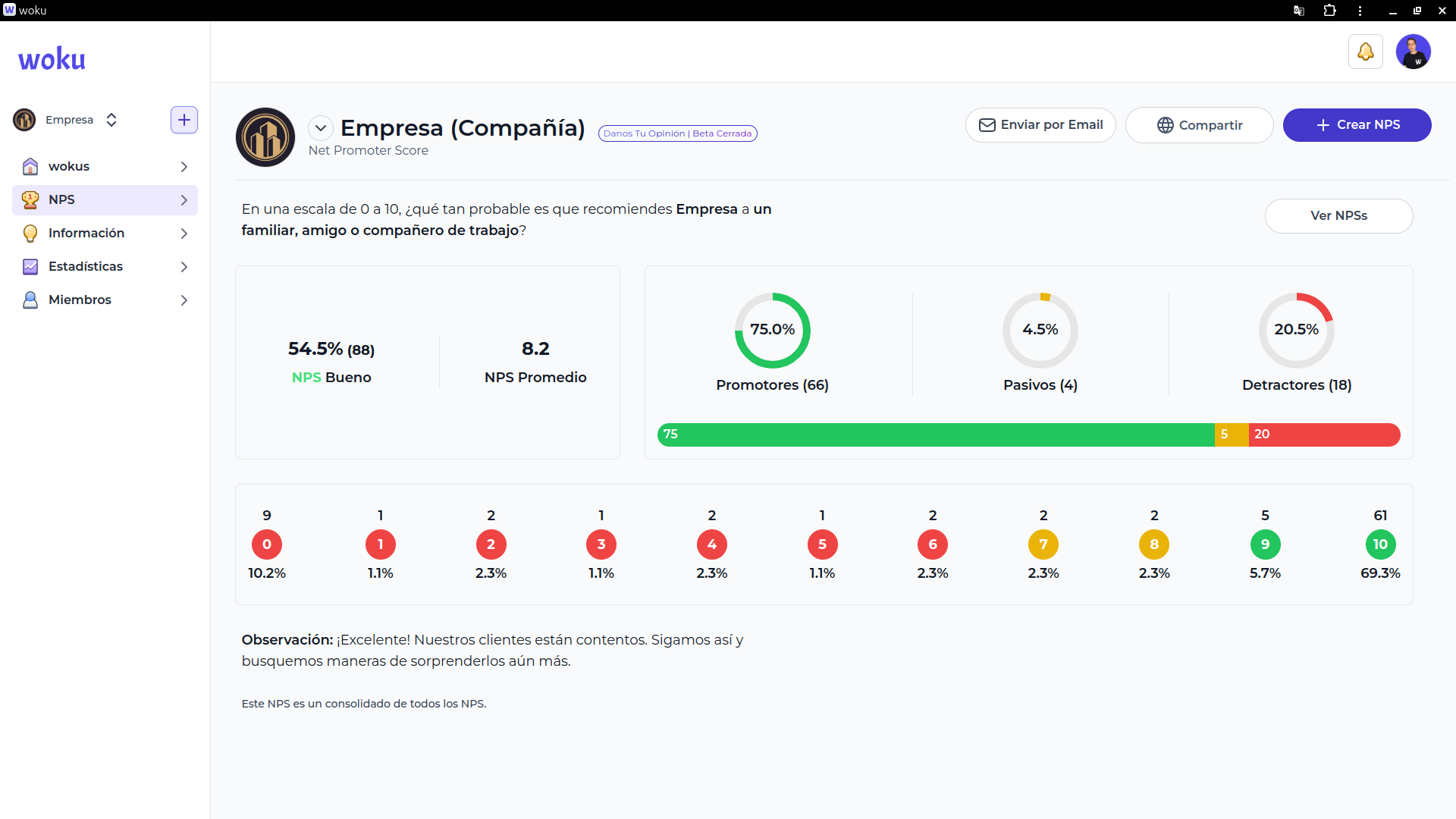
Baehre et al. (2022) conducted an empirical study that yielded interesting conclusions about NPS as a predictor of sales growth. Below, I'll share some of those findings to explain why we decided to integrate the NPS into woku.
What is NPS and why is it so popular?
The NPS was introduced in 2003 with the promise of being “the only number you need to grow”. Its simplicity made it very attractive to companies: it is based on a single question, “Would you recommend our brand to a friend or colleague?” The answers are scored from 0 to 10, and respondents are divided into three groups: promoters (9-10), passives (7-8) and detractors (0-6). The idea is that, by increasing the number of promoters and reducing the number of detractors, brands can boost sales.
However, not everyone is convinced. Several academics have questioned the accuracy of the NPS and have questioned whether it really is a good predictor of sales growth.
The Key Turning Point: From Customer Loyalty to Brand Health
A relevant finding of the study is that many companies have changed the way they use NPS. Originally, it was used to measure the loyalty of current customers, but now many brands, such as Apple and Best Buy, use it to evaluate “brand health”, surveying both current and potential customers.
This broader approach allows brands to understand not only how their current customers feel, but also what the overall perception of the brand is like in the market. And this is where NPS offers additional value: not only does it measure loyalty, but it can also help predict future growth when used as an overall brand health metric.
The key is in change, not in absolute levels
The study analyzed the NPS and sales data of seven major sports brands over five years and concluded that brands that improve their NPS over time are more likely to see sales growth. In other words, it's not just about achieving a high NPS, it's about constantly improving it.
Importantly, NPS seems to be a good predictor of sales growth in the short term, approximately one quarter. In addition, it's most effective when used to measure the perception of all potential customers, not just current customers.
What does this mean for your company?
If you're using NPS in your company, there are some key lessons you can learn from this study:
- Focus on improving: Don't get obsessed with achieving a perfect NPS. The important thing is that you see constant improvements in your score, which indicates that you are moving in the right direction.
- Measure the health of your brand: Consider surveying not only your current customers, but also your potential customers. This will give you a more complete view of how your brand is positioned in the market.
- Think in the short term: NPS is more useful for predicting short-term growth. If your goal is to increase sales quickly, NPS can be a valuable tool, but don't use it for long-term predictions.
Should you continue to use NPS?
According to the study, the NPS remains a useful tool, although with some important considerations. It's a good indicator of brand perception and can help you forecast sales growth in the short term, as long as you focus on improving your score and reach out to all potential customers. That's why combining the power of NPS with tools such as woku can provide vital information to understand your customers' relationship with your company and help you improve the customer experience.
References ÷
- Baehre, S., O'Dwyer, M., O'Malley, L., & Lee, N. (2022). The use of Net Promoter Score (NPS) to predict sales growth: Insights from an empirical investigation. Journal of the Academy of Marketing Science, 50 (1), 67-84.