When programming became a conversation and woku wants that too

Last year, programming became a conversation. At woku we want the same thing: fewer buttons, more conversation and operational objectives solved quickly (without suffering the learning curve).
Last year something changed (as expected): making software became more comfortable. Not “a little bit faster”. Really comfortable.
With tools like Claude Code or Cursor, we went from “fighting with the code” to “let's talk for a while and get it out”. And yes: that also makes it more entertaining. Almost suspiciously entertaining.
From researching 40 minutes to asking 40 seconds
Before, the flow was more or less like this:
- I have an idea
- I'm looking for docs
- I read 5 tabs
- I test
- I'm wrong
- I repeat
- end; no, it was a semicolon
Now a lot of times it's:
- I have an idea
- I say it in normal words
- The code appears
- I'll check it, I adjust
- And I pretend that I always knew what it was like
That part of translating thoughts into “machine language” became much more direct. Not perfect, but ridiculously faster.
(I'm oversimplifying the process, but it's an exemplification)
The high (yes, dopamine) and the “vibe” of creating
There's one detail that nobody explains to you in the tutorials: when the loop is fast, your brain gets hooked.
In my case it happens like this: I write (or convert), I execute, I see results. And when that happens in minutes, the feeling is: “ok, I can build anything”.
Obviously I can't build anything. But in that moment... it feels infinite. And that, for a CTO, is basically premium gasoline.
If the software is being talked about... why do we keep filling it with buttons?
And that's where my doubt began to creep in.
If today I can “talk” with the code, why do we continue to force people to use software?
- learn where each button is,
- understand what each input means,
- Remember the correct flow
- and suffer when we change the UI (sorry)?
Since LLMs exploded and things like Lovable, v0 or Notion's AI began to appear, there's a very clear trend: fewer menus, more conversation.
Not because the buttons are bad. It's because, for many people, buttons are... an eternal learning curve.
The Learning Curve: That Silent Enemy
Most products try to solve this with onboarding:
- manuals
- guided tours
- Tooltips
- videos
- and some PDF that no one asked for
It works... at first.
But then life goes by: updates, changes, new features, equipment rotation, the user returns after two weeks and thinks:
“Where was that thing that I could do before?”
And voila, resetted learning curve. Again.
Conversation as “infinite onboarding”
The beauty of a conversational interface is simple:
it doesn't require you to remember the software.
It lets you talk like a human.
The conversation feels like an expert assistant who:
- It guides you,
- understand what you want to achieve,
- It asks you questions when data is missing
- and it saves you the heavy part (the most hungry)
It's basically a constant onboarding.
And if that's possible... then we want it to be possible in woku as well.
What do we want you to feel in woku
What I would like is for our users to be able to achieve their operational objectives with the same speed and pride that is felt today when building software in conversation.
No “more options”. Not “another panel”. Not “a new button that is now on the top right”.
Rather:
- “I want to create a folder for my Providencia branch”
- “I need a form to request a name and email”
- “send NPS for returning customers”
- “show me what's going on with the reviews this week”
And let Woku respond like a teammate who knows.
Spoiler: Before talking, woku had to dress better
Now, this is not integrated by pressing a magic button (what an irony, isn't it?).
Before we had a conversation, we had to leave the house tidy. So let's start with the basics:
- We renewed the landing page
- we renewed the tool for capturing reviews
- and now we are renewing the administration panel
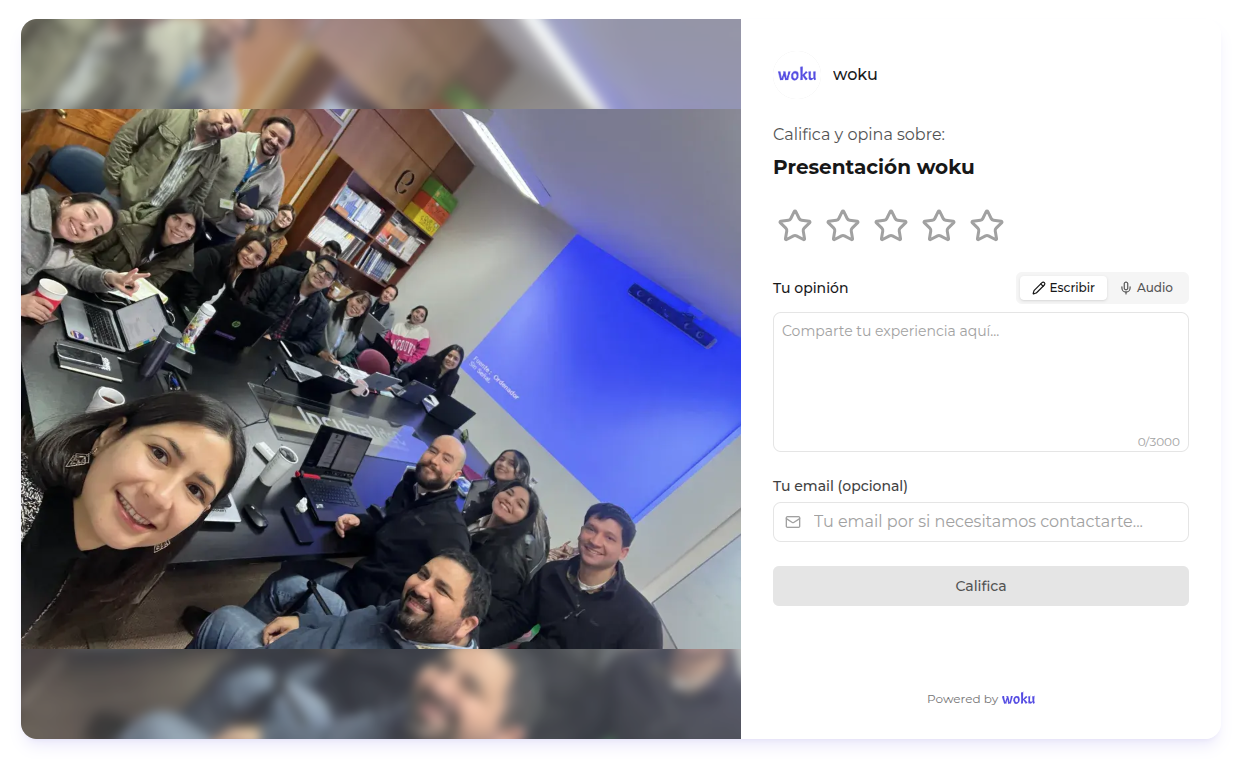
If we are going to promise a “modern” experience, the app has to look up to the task. Because there's nothing sadder than a futuristic chat inside an old interface.
March: The conversation sits behind the wheel
The goal is that in March we can launch this new vision:
That creating woku, folders, forms (at the request of our client Gonzalo de Colbún, who doesn't want to leave woku), integrate NPS, request data from clients and configure flows... can be done in conversation.
And if you're still nostalgic for buttons and inputs. Don't worry, we'll keep them.
Not because they're the best.
But because we all have a conservative side... especially when it comes to getting the hang of it quickly.
And yes, I wrote this post while Claude Code was doing his homework.